

11 Steps to Crochet the Sage Bloom Hobo Bag: A Complete Pattern Guide
A sage green crochet tote bag pattern needs more than an attractive stitch repeat: the base, lace count, gathered rim and tapered handle must work together. This PDF-grounded guide follows the supplied construction data in eleven checkpoints and uses independent instructional visuals rather than crops. Make and test a complete sample before describing the design as fully tested.
In this article
- Gather materials, check gauge and plan the finished size
- Crochet the six-round oval base
- Build the dense lower structural band
- Set the 26-space lace foundation
- Work the shell and recovery rounds
- Add the floral cluster rounds
- Repeat the floral lattice to full height
- Gather and stabilize the upper rim
- Crochet the symmetrical wide handle
- Attach and reinforce the handle
- Finish the tab, lining, blocking and load test
1. Gather materials, check gauge and plan the finished size
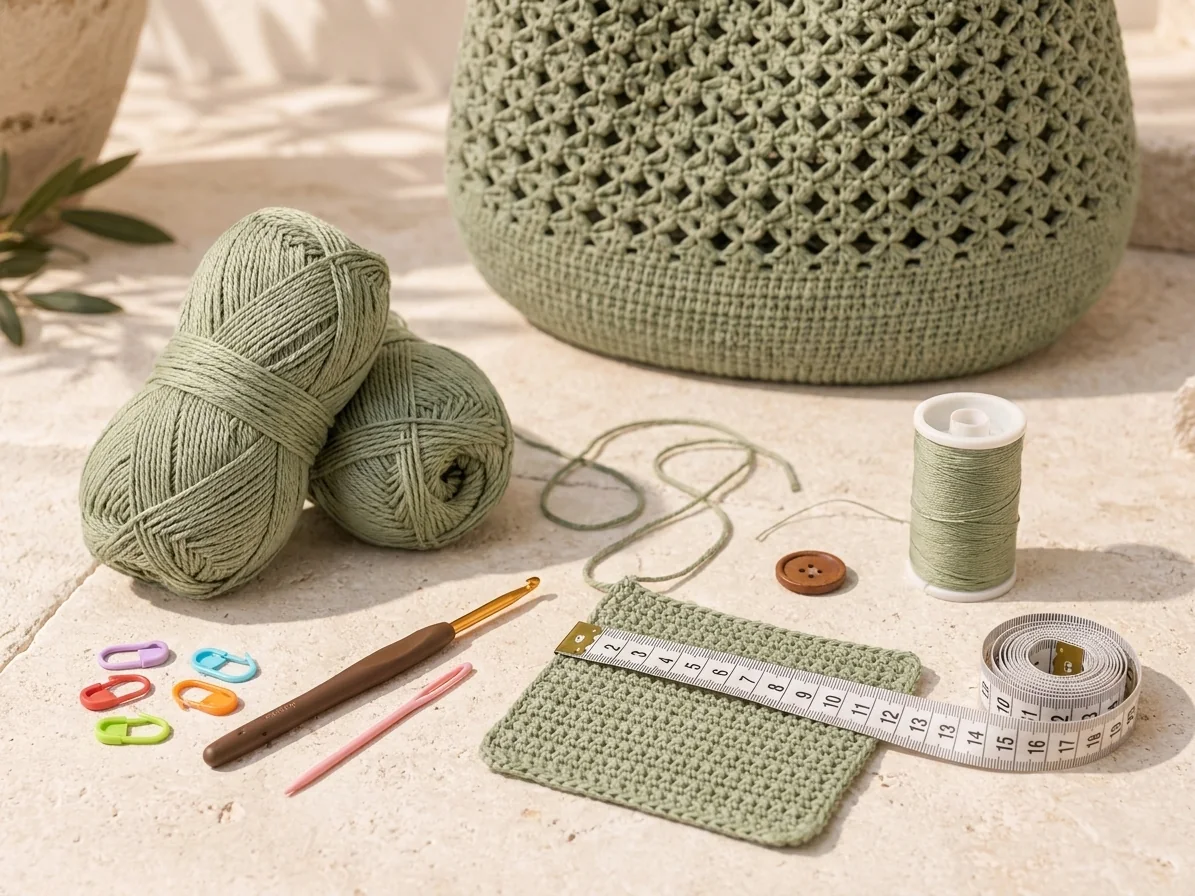
Choose 500–600 m (545–655 yd) of firm DK cotton, cotton-linen, or 2 mm braided cotton cord. Use a 4 mm hook, with an optional 3.5 mm hook for a firmer handle. Prepare four locking markers, a needle, strong thread, scissors, measuring tape and one 22–25 mm wooden button. Make a washed and lightly blocked single-crochet swatch. The pattern gauge is 17 sc by 19 rows over 10 by 10 cm. Finished targets are 35–38 cm wide, 32–35 cm high, a 30 by 9 cm base, a 23–25 cm opening and a 30–33 cm handle drop. Measure rather than assuming your tension matches.
Used as a practical checkpoint, sage green crochet tote bag pattern becomes easier to understand and repeat without rushing the details.
2. Crochet the six-round oval base
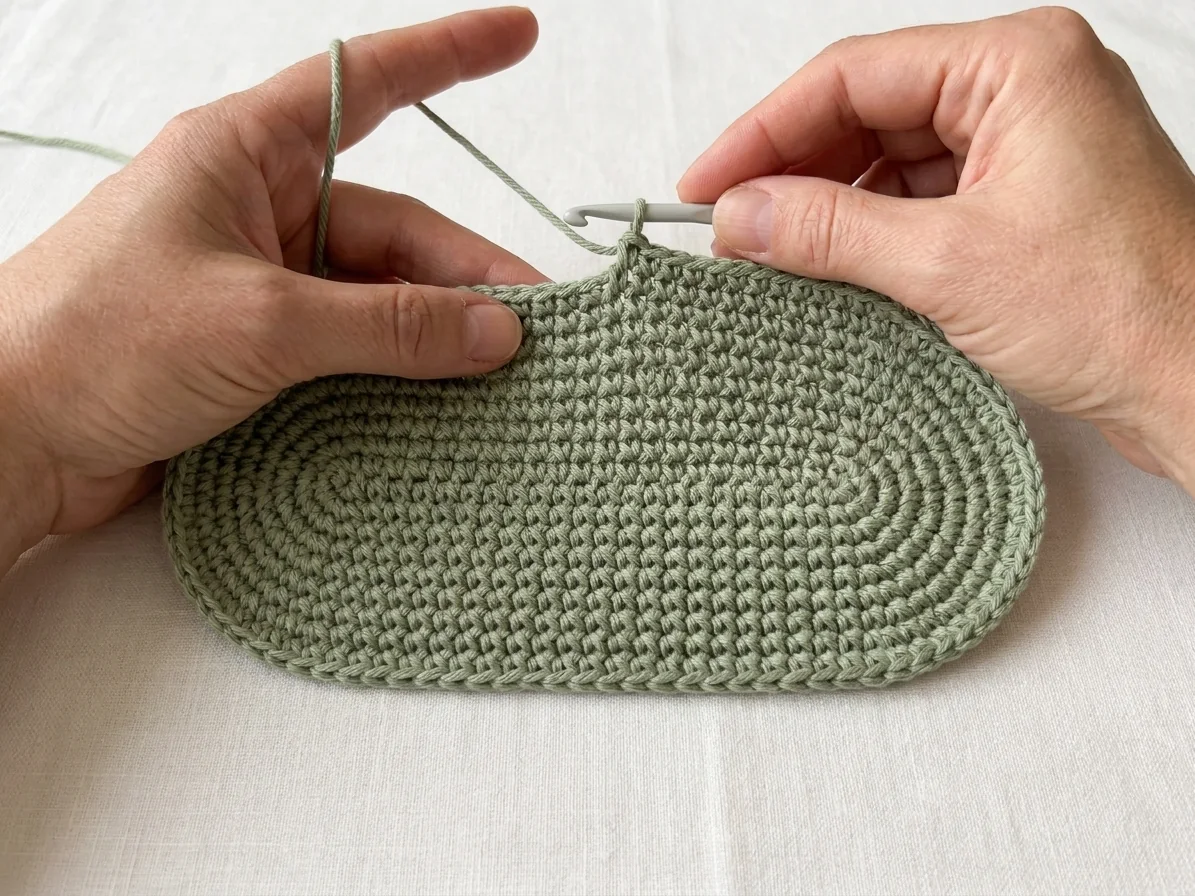
Chain 31. For Round 1, place 2 sc in the first chain, sc across 28, work 4 sc at the end, continue along the opposite side with 28 sc and finish with 2 sc for 64 stitches. Join carefully without twisting. Increase only on the curved ends while keeping 28 straight stitches on each long side. The totals progress 64, 72, 80, 88, 96 and 104. After Round 6, the oval should lie flat and measure approximately 29–31 cm long by 8–10 cm wide. A cupping base suggests tighter tension; rippling suggests a smaller hook or fewer final increases.
Used as a practical checkpoint, sage green crochet tote bag pattern becomes easier to understand and repeat without rushing the details.
3. Build the dense lower structural band
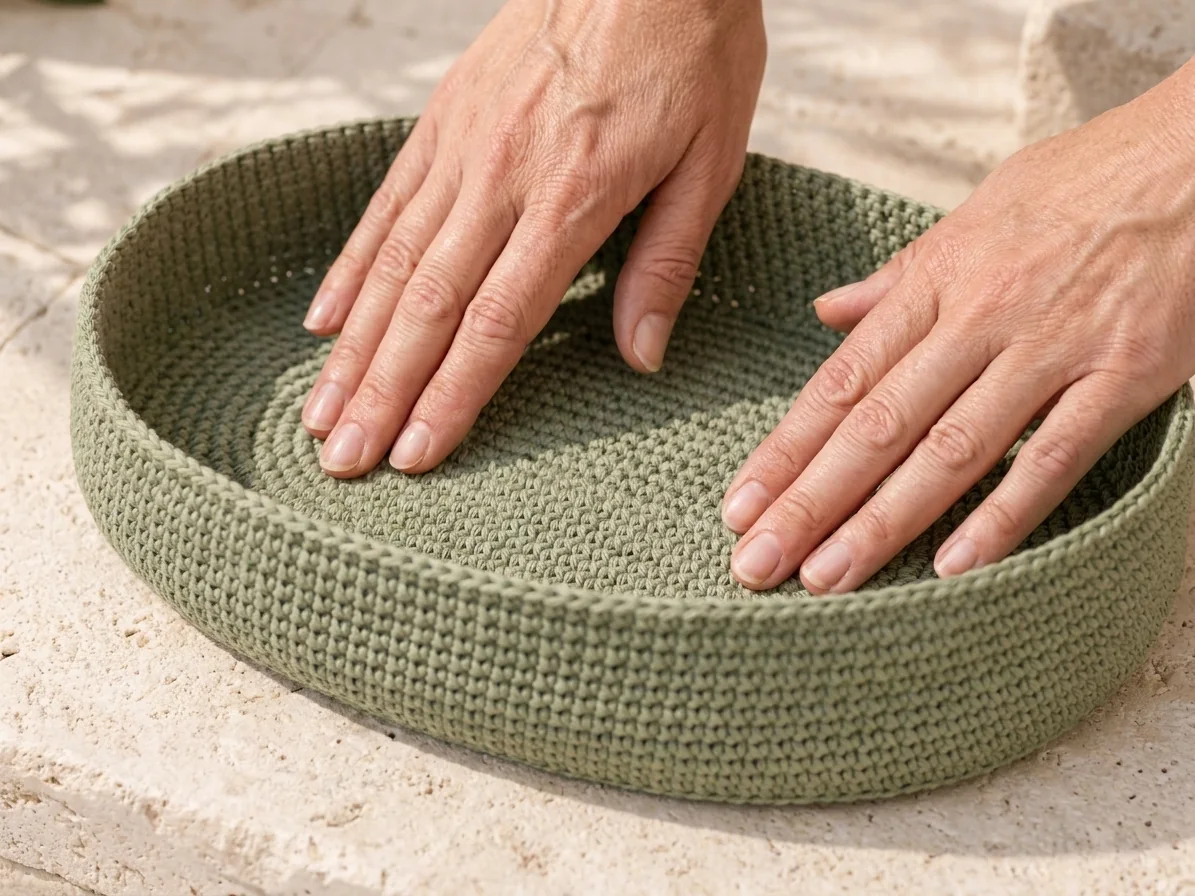
Work Round 7 through back loops only to create the turning ridge, keeping 104 stitches. Work Rounds 8–15 in single crochet with 104 stitches each round. Keep the join centered at the back when possible. The band should stand about 4–5 cm above the ridge. This compact fabric supports the airy body and gives contents a more stable resting area. Count at each join so an accidental increase does not distort the later 26-repeat lace setup.
Used as a practical checkpoint, sage green crochet tote bag pattern becomes easier to understand and repeat without rushing the details.
4. Set the 26-space lace foundation
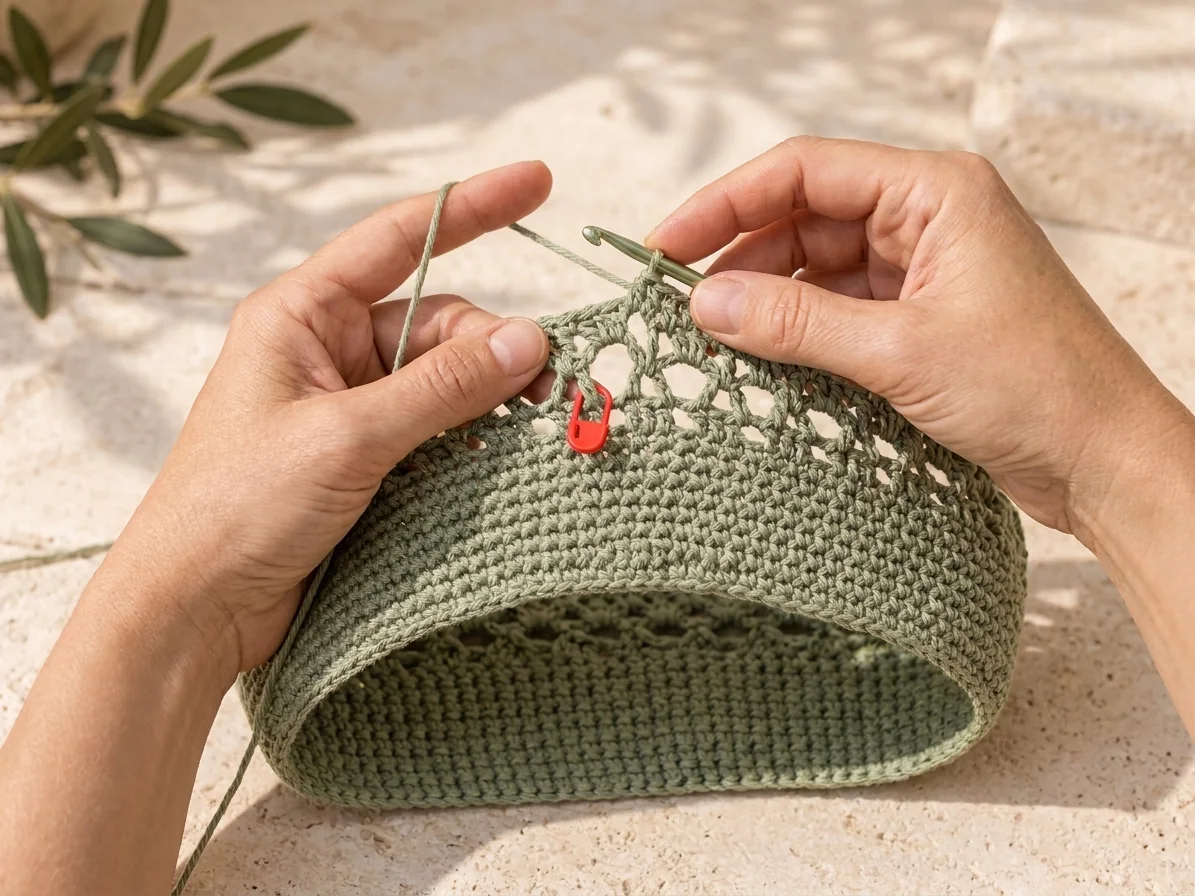
For Round 16, repeat one single crochet, chain 5 and skip 3 stitches around, then join. The result is exactly 26 single crochets and 26 chain-five spaces. Pay special attention to the spaces immediately before and after the join. Place a marker at the join and recount all 26 spaces before continuing. This foundation determines whether every shell and blossom aligns through the body.
Used as a practical checkpoint, sage green crochet tote bag pattern becomes easier to understand and repeat without rushing the details.
5. Work the shell and recovery rounds
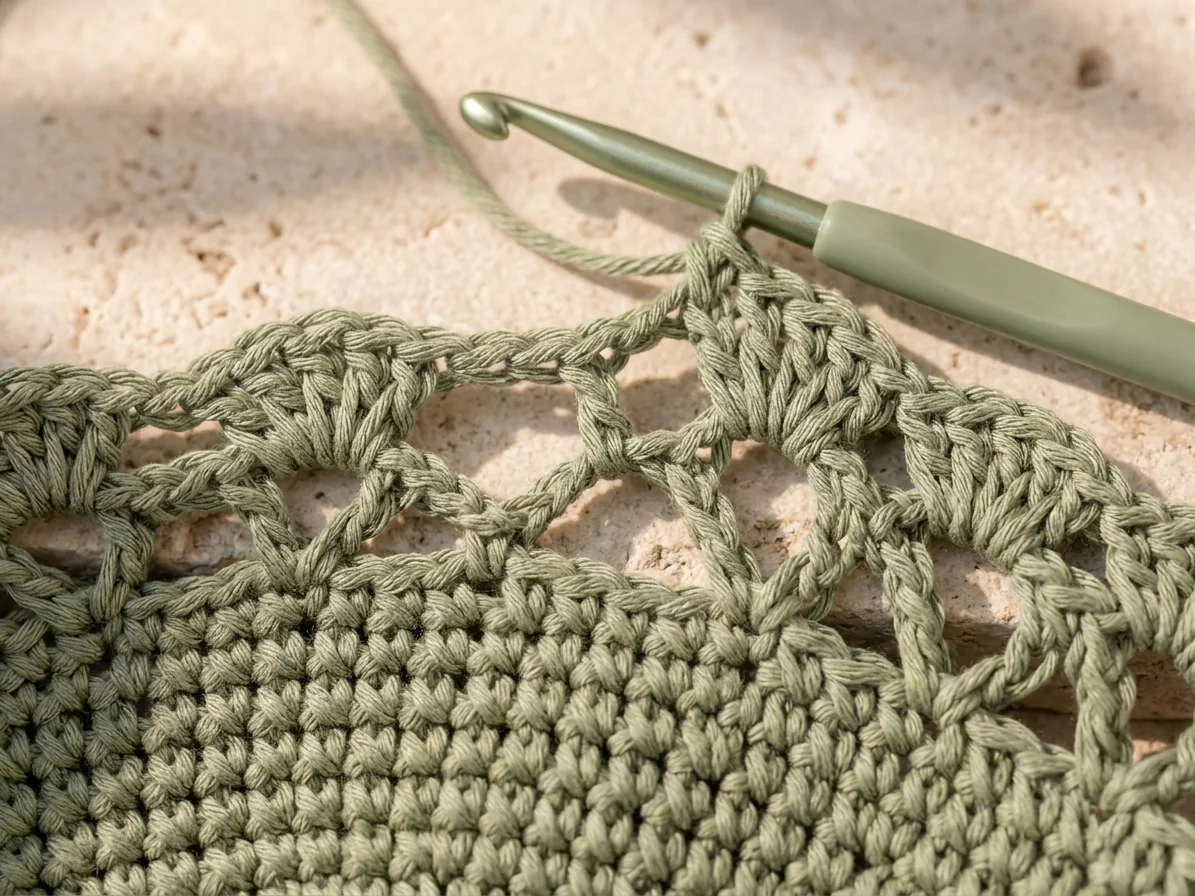
Round A places a shell in every chain-five space: 2 dc, ch 2, 2 dc, with ch 1 between shells. Round B places one sc in each shell ch-2 space with ch 5 between, restoring 26 chain spaces. Keep the shells open but controlled. Beginning chains do not count unless the pattern says otherwise. At the join, identify the true last space rather than adding an extra repeat; the total must remain 26.
Used as a practical checkpoint, sage green crochet tote bag pattern becomes easier to understand and repeat without rushing the details.
6. Add the floral cluster rounds
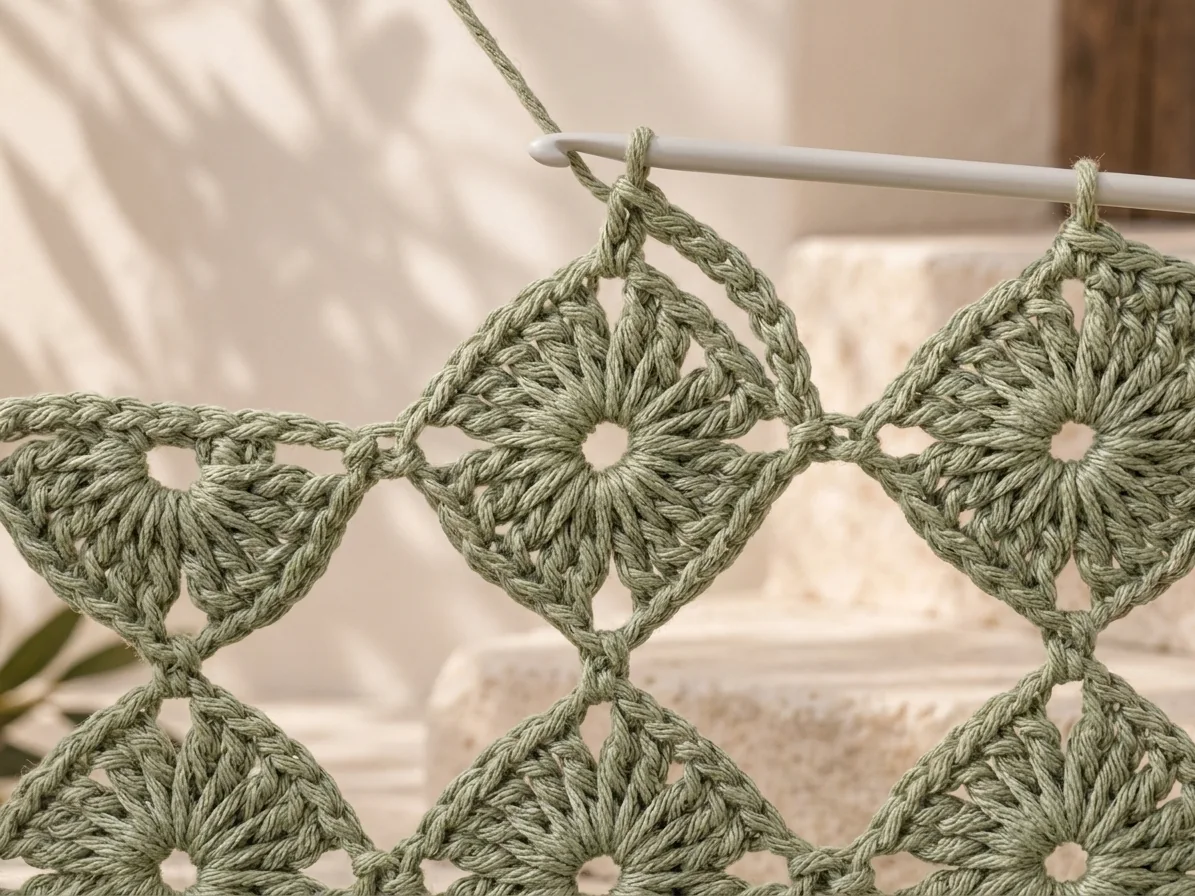
For Round C, work sc, ch 2, dc3tog, ch 2, sc in each chain-five space, followed by ch 1. This makes 26 blossoms. For the cluster, begin three double crochets in the same space and draw through all four loops together. Round D places sc in each cluster top and ch 5 between, returning to 26 chain-five spaces. Gently spread the fabric to check that every blossom has two balanced side chains and that the join has not swallowed a space.
Used as a practical checkpoint, sage green crochet tote bag pattern becomes easier to understand and repeat without rushing the details.
7. Repeat the floral lattice to full height
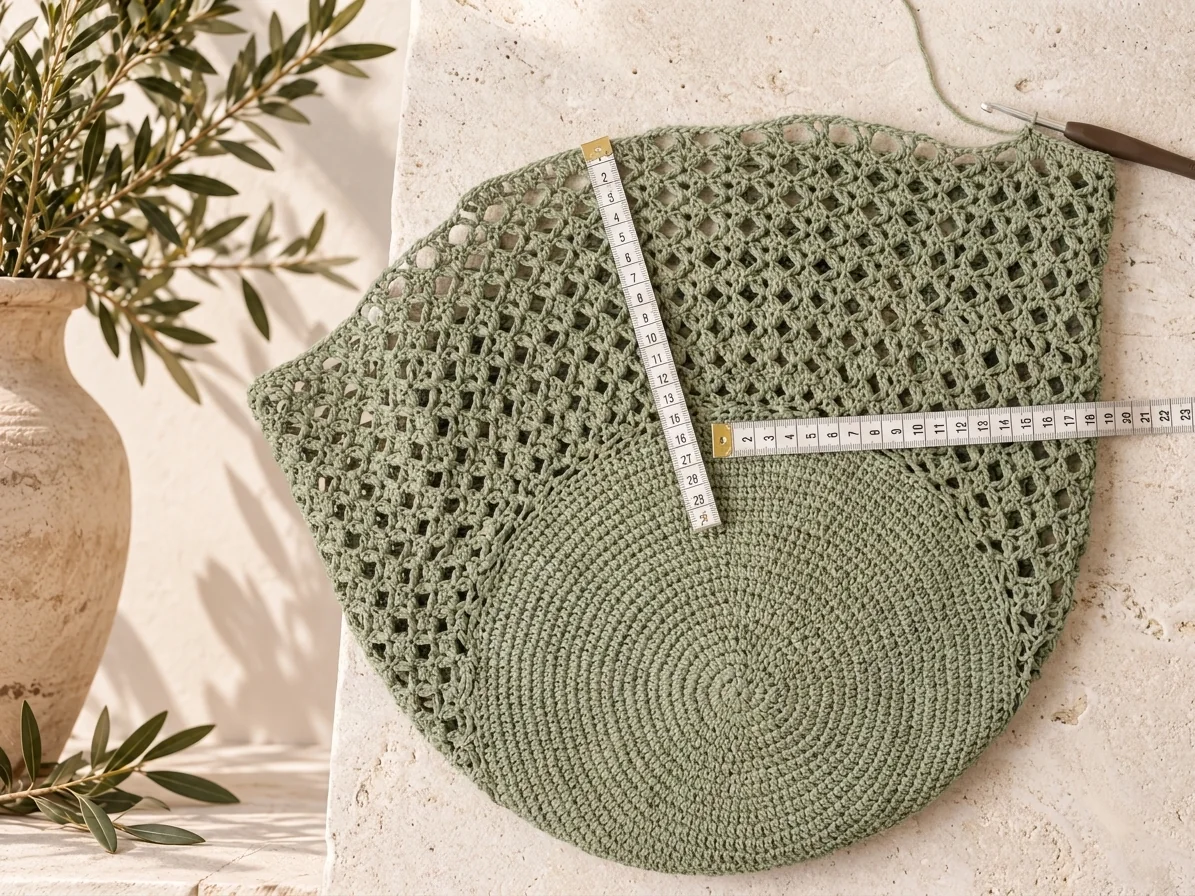
The main eight-round sequence is A–B three times, then C–D once. Work three complete sequences for the standard body. Stop when the lace measures 21–23 cm from Round 16 and end after Round B or D. For a shorter version, work two full sequences and then A–B once more. Count 26 repeats after every round. Correct a missing or extra repeat immediately; carrying the error upward changes the opening and makes the rim reductions uneven.
Used as a practical checkpoint, sage green crochet tote bag pattern becomes easier to understand and repeat without rushing the details.
8. Gather and stabilize the upper rim
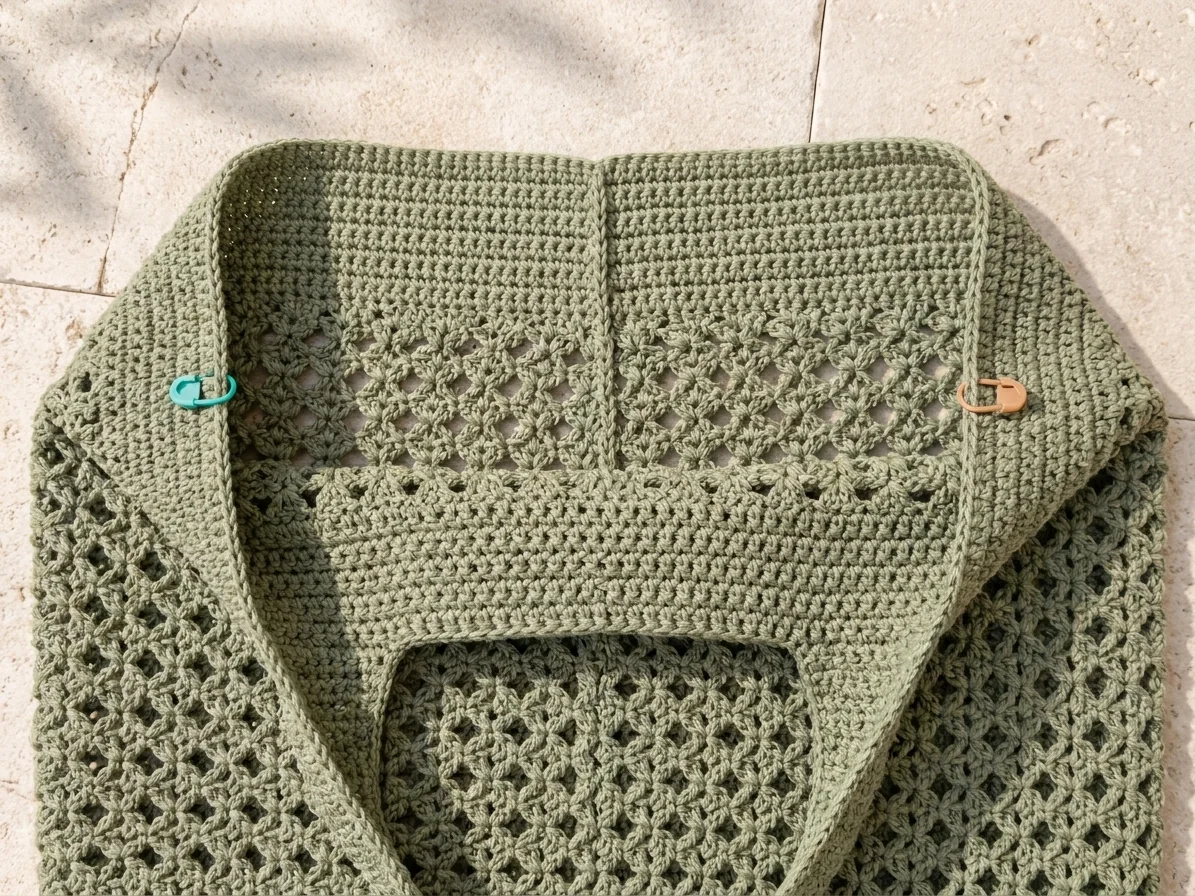
Transition by working 4 sc into each of the 26 chain-five spaces for 104 stitches. On Rim Round 1, repeat sc 11 and sc2tog eight times for 96 stitches. On Rim Round 2, repeat sc 10 and sc2tog eight times for 88 stitches. Work Rim Rounds 3–6 even at 88. Lay the bag flat with the seam centered at the back. At each side fold, mark a centered group of 14 rim stitches. Confirm both groups sit directly opposite before making or attaching the handle.
Used as a practical checkpoint, sage green crochet tote bag pattern becomes easier to understand and repeat without rushing the details.
9. Crochet the symmetrical wide handle
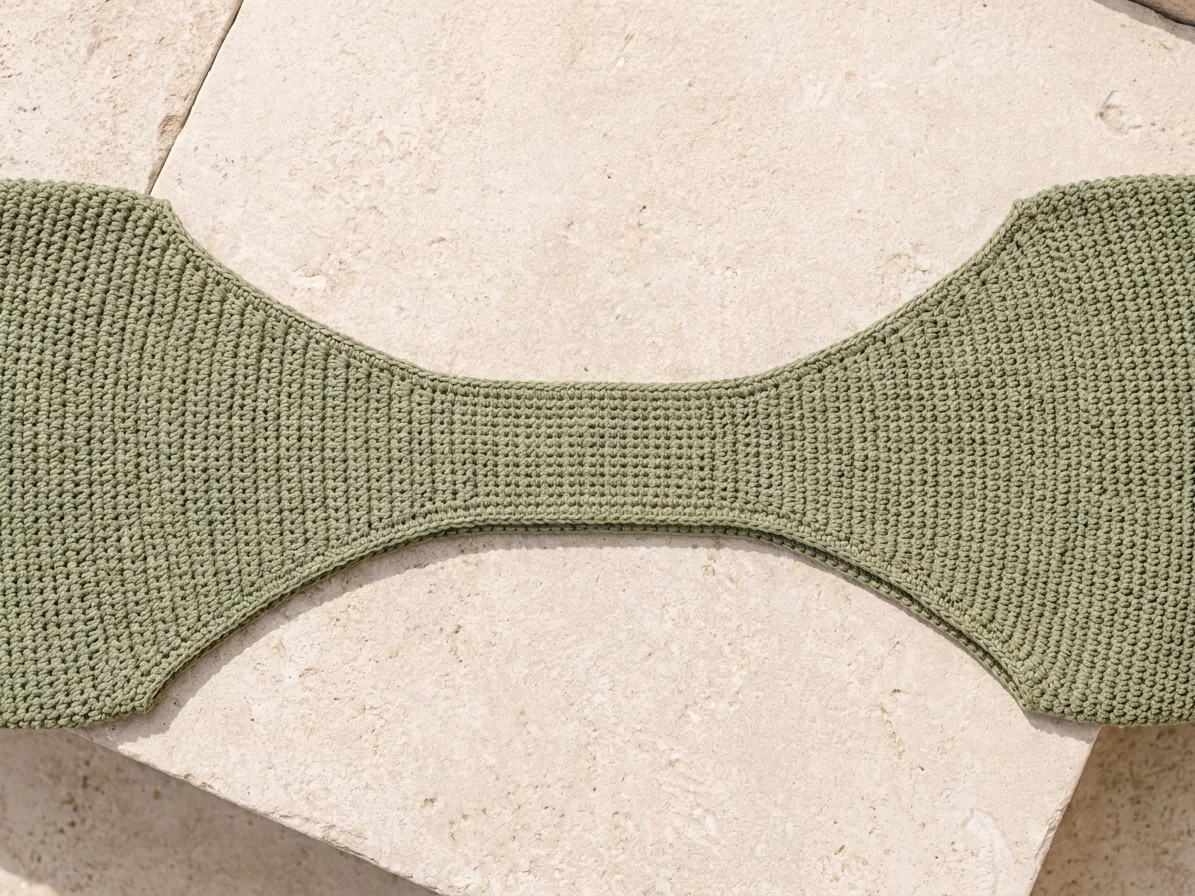
Make one handle separately. Begin with 14 sc and work Rows 1–8 even. Row 9 reduces to 12 stitches; work Rows 10–16 even. Row 17 reduces to 10 stitches. Continue on 10 sc until the handle measures 62–68 cm. Reverse the shaping: increase to 12, work seven even rows, increase to 14, then work eight even rows. The complete width sequence is 14 to 12 to 10 to 12 to 14. Block the handle before attachment and confirm the final drop against the bag.
Used as a practical checkpoint, sage green crochet tote bag pattern becomes easier to understand and repeat without rushing the details.
10. Attach and reinforce the handle
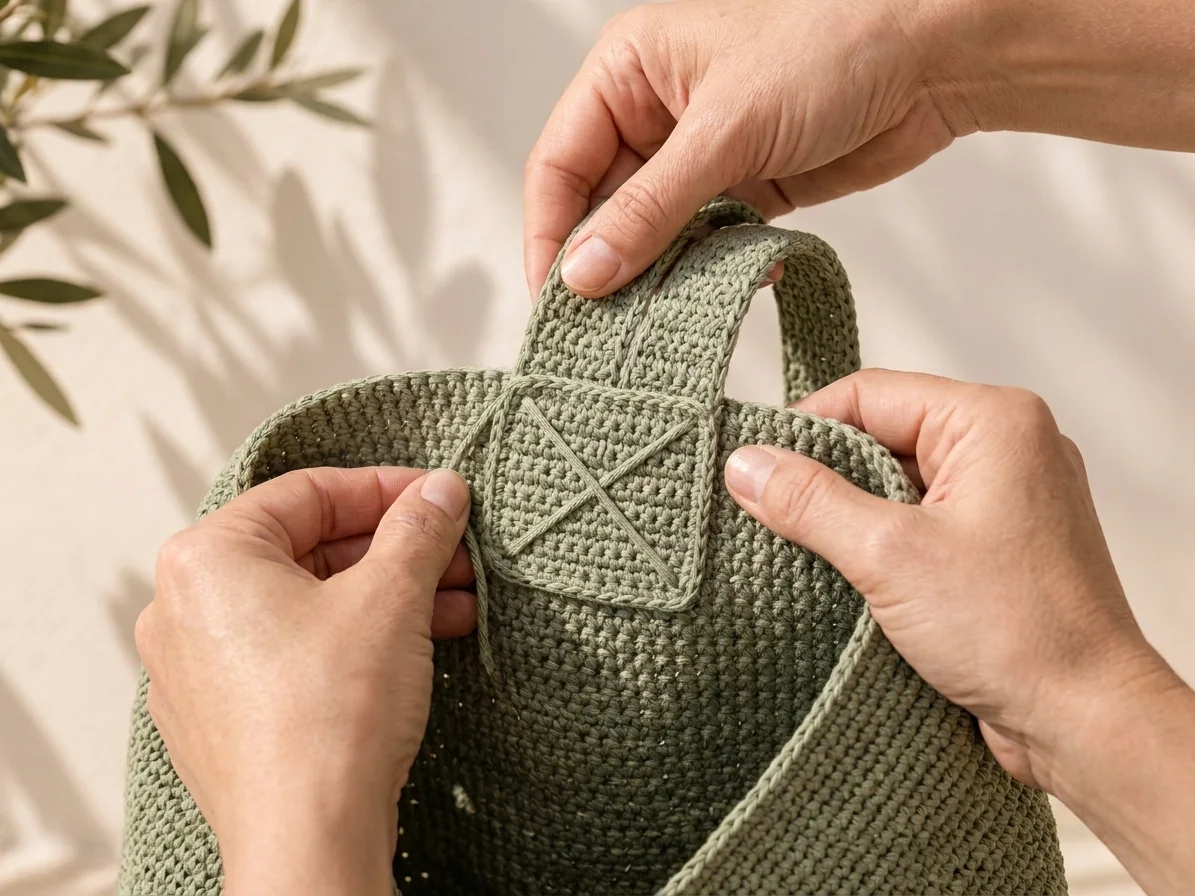
Place each 14-stitch end inside its marked rim section with a 3 cm overlap. Check that the handle is not twisted, then pin both ends. Sew through the dense rim, not the open lace. Use a reinforced rectangle with a diagonal X at each end. For regular carrying, repeat the reinforcement with strong matching sewing thread. Inspect both attachment zones from inside and outside so skipped stitches or loose corners can be repaired before lining.
Used as a practical checkpoint, sage green crochet tote bag pattern becomes easier to understand and repeat without rushing the details.
11. Finish the tab, lining, blocking and load test
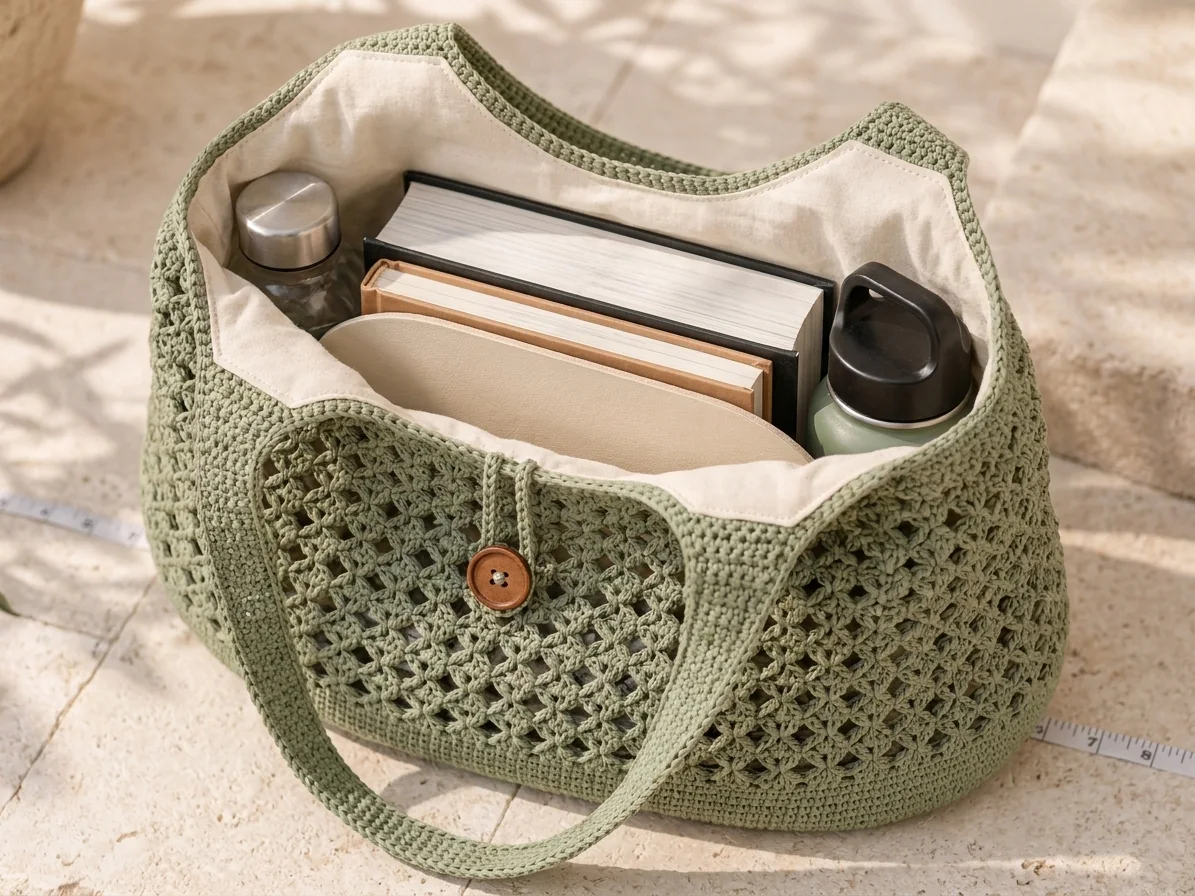
For the tab, chain 6 and work 5 sc wide for ten rows. Make the loop row with sc 2, ch 8, skip 1 and sc 2; on the final row work sc 2, 10 sc around the loop and sc 2. Attach it at the back so it folds forward over the button.
If adding a lining, block first, trace the body excluding the handle, add 1.5 cm side and bottom allowances and 2.5 cm at the top, then hand-sew it below the rim. Weave tails into dense fabric, open the lattice while blocking and dry flat. Test a completed sample with 2–3 kg (4½–6½ lb) for 30 minutes, then inspect the base, rim and joins. This image-inspired interpretation should be fully crocheted, measured, wear-tested and independently tech-edited before being sold as tested.
Used as a practical checkpoint, sage green crochet tote bag pattern becomes easier to understand and repeat without rushing the details.
Final checklist
- Review every measurement or packing choice before use.
- Keep the dense base, openwork body, rim, closure and handle in proportion.
- Photograph or note the result so future adjustments are consistent.
- Follow the yarn or finished-item care information actually available to you.
The best results come from treating sage green crochet tote bag pattern as a complete system rather than a single decorative idea.
Frequently asked questions
Can I substitute another yarn?
Use a firm yarn that can meet gauge and produce a stable fabric. Swatch, wash and measure before committing; substitutions change yardage and drape.
Why must the lace stay at 26 repeats?
The fixed repeat count aligns the shell and blossom rounds with the 104-stitch transition and keeps the rim gathering balanced.
Is the lining required?
No. It is optional, but it can contain small items and hide reinforcement. Cut it only after the crochet is blocked.
Continue with mindful gift basket layers around the tote or explore seasonal care routines to protect the finished bag.