
MY CROCHET UNIVERSE · BABY CROCHET PATTERN
Crochet Bunny Baby Booties Pattern for 3–6 Months
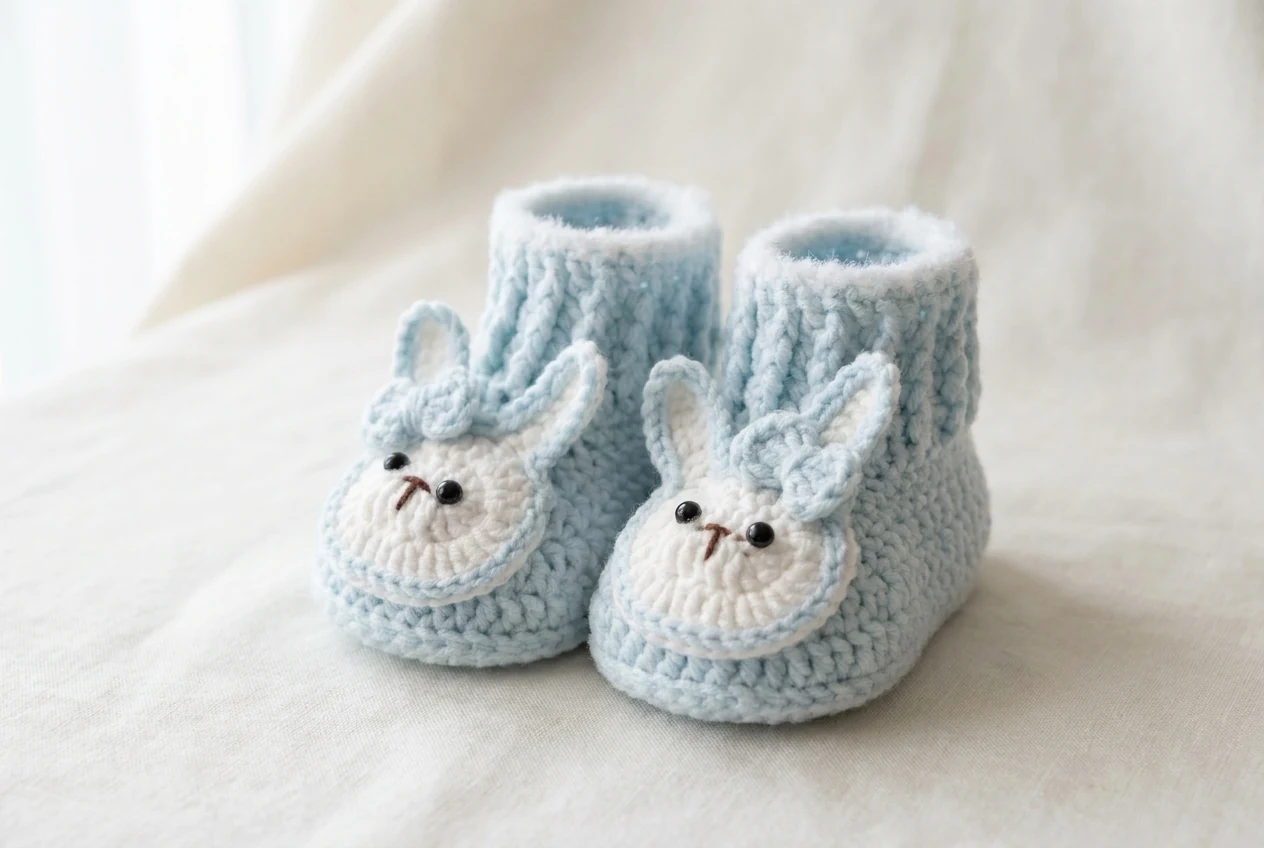
This crochet bunny baby booties pattern creates a soft pair of pale-blue ankle booties with rounded oval soles, shaped toes, tall raised-stitch cuffs, and white bunny-face appliques. The supplied source labels the size as 3–6 months. It does not provide yarn weight, hook size, gauge, or finished sole length, so measure the work before treating that age range as a guaranteed fit.
In this crochet bunny baby booties pattern, the booties are made from the sole upward. Three oval rounds establish the base, front-loop-only stitches turn the fabric vertically, decrease rounds shape the toe, and alternating front-post and regular double crochet creates the ribbed cuff. A separate bunny applique and tiny bow complete each toe.
Table of Contents
- Project details
- Materials
- Abbreviations
- Sizing
- Written pattern
- Step-by-step tutorial
- Assembly
- Safety
- Troubleshooting
- FAQ
Project Details
| Detail | Value |
|---|---|
| Source size label | 3–6 months |
| Construction | Oval sole, joined upper, shaped toe, textured cuff, sewn applique |
| Main stitches | sc, hdc, dc, dc2tog, front-post dc, slip stitch |
| Pieces | Two soles/uppers, two bunny faces with ears, two bows |
| Skill level | Confident beginner to intermediate |
For the crochet bunny baby booties pattern, the most important checkpoints are the sole size, the position of the toe decreases, and the cuff count. Work both shoes in parallel so your tension remains similar.
Materials
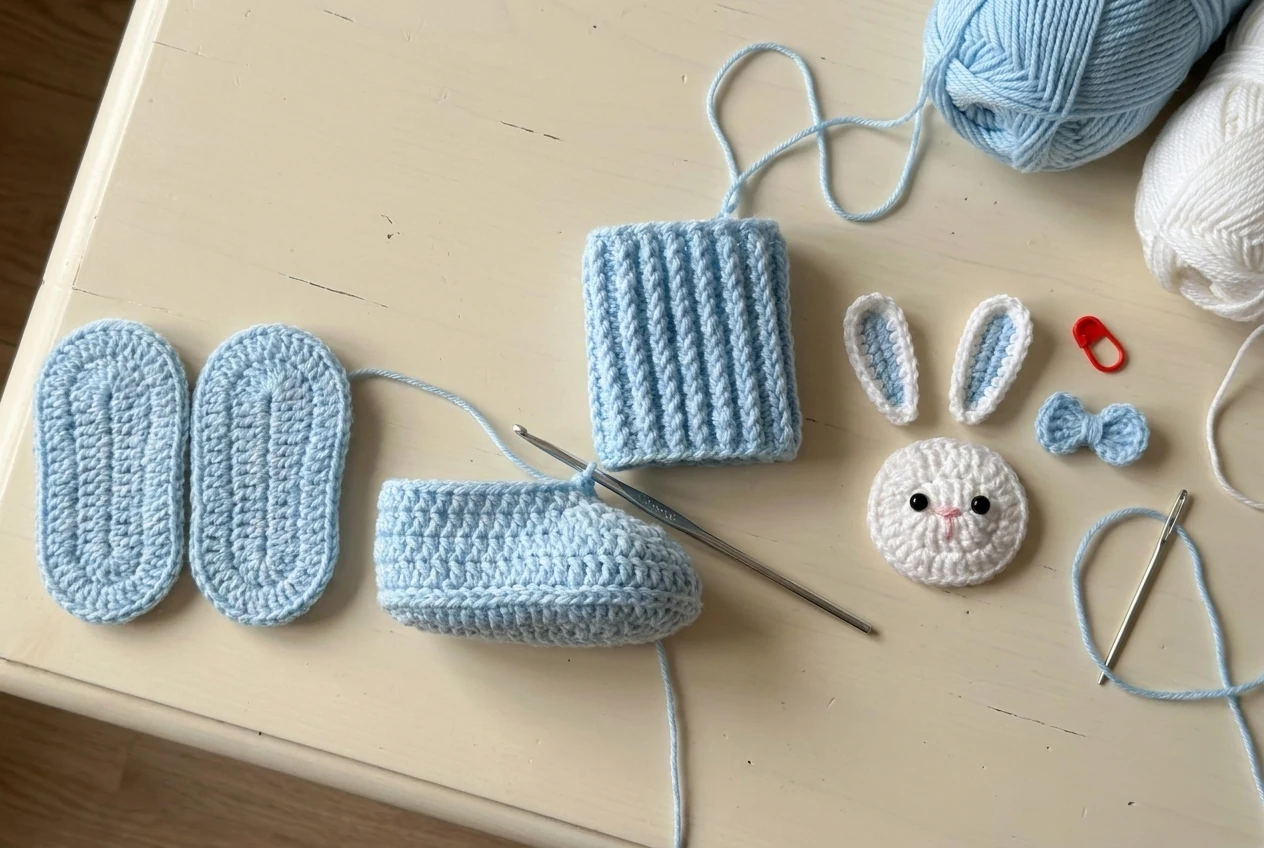
- Smooth baby-safe yarn in pale blue and white; the source does not state a yarn weight.
- A crochet hook that produces a firm but flexible fabric with your chosen yarn.
- Tapestry needle, scissors, removable stitch markers, and a tape measure.
- Brown embroidery floss for the nose and mouth.
- Black embroidery floss for infant-safe eyes; avoid detachable safety eyes on items for babies.
- Optional soft fuzzy white yarn for the cuff or edging, provided fibers do not shed.
For this crochet bunny baby booties pattern, choose yarn that does not split and a hook that creates close stitches without making the sole stiff. The sample uses pale blue for the body and edging, white for the bunny face and inner ears, brown embroidery for the nose, and black facial details.
Abbreviations
| Source symbol | US term used here |
|---|---|
| ch | chain |
| sl / sl st | slip stitch |
| X | single crochet (sc) |
| V | single-crochet increase |
| A | single-crochet decrease |
| T | half double crochet (hdc) |
| F | double crochet (dc) |
| FV | double-crochet increase |
| FA | double-crochet decrease (dc2tog) |
| FLO | front loop only |
| front-post dc | double crochet around the post from the front |
The source uses FW at both ends of the foundation chain. In context, that is treated as three double crochets in one chain, the common double-crochet version of a three-stitch end increase. Count and compare the two ends of the sole so the oval remains symmetrical.
Sizing and Gauge
Before following the full crochet bunny baby booties pattern, make one sole through Round 3 and measure it. Compare with the baby’s foot while allowing comfortable toe room. If the sole is too long, changing to thinner yarn or a smaller hook is more reliable than deleting random stitches, because every upper round is built on the sole count.
If the sole is the right length but too narrow, check whether the seven-double-crochet end cluster and all Round 2 increases were completed. If it is too wide, your loop height may be looser than the source sample.
The screenshot sequence appears to move from a Round 5 total near 31 stitches to “32 dc” in Round 6. This may reflect an unshown join or a shorthand inconsistency. Preserve the shaping, place the round start at the back, and make both booties identical rather than forcing an invisible extra stitch into the toe.
Written Pattern
Sole — make two
- Round 1: Ch 14. Starting in the third chain from the hook, work 3 dc in that chain, 10 dc, 7 dc in the last chain, 10 dc along the opposite side of the foundation chain, and 3 dc in the remaining end space. Join.
- Round 2: Work 3 dc increases, 10 dc, 3 dc increases, 1 dc, 3 dc increases, 10 dc, and 3 dc increases. Join.
- Round 3: Work (sc, sc inc) 3 times, 3 sc, 3 hdc, 4 dc, (dc inc, dc) 6 times, 1 dc inc, 4 dc, 3 hdc, 3 sc, then (sc inc, sc) 3 times. Join.
Bootie upper — make two
- Round 1: Working in the front loop only, 2 dc, dc2tog, 50 dc, dc2tog, 2 dc.
- Round 2: 1 dc, dc2tog, 15 dc, (dc2tog, dc) 6 times, dc2tog, 15 dc, dc2tog, 1 dc.
- Round 3: 15 sc, 2 hdc, (dc2tog, dc) 4 times, dc2tog, 2 hdc, 14 sc.
- Round 4: 14 sc, 2 hdc, dc2tog 5 times, 2 hdc, 14 sc.
- Round 5: 11 sc, 2 hdc, dc2tog 5 times, 2 hdc, 11 sc.
- Round 6: 32 dc.
- Rounds 7–9: Alternate 1 front-post dc and 1 regular dc around to create the raised cuff texture.
- Tie: Ch 60 as written in the source. Check the finished length before use and secure the ends carefully.
Bunny face and ears — make one applique for each bootie
- Round 1: Ch 6. Starting in the third chain from the hook, dc inc, 2 dc, 6 dc in the end chain, 2 dc along the opposite side, then 4 dc in the first-chain end.
- Round 2: Ch 2, 2 dc increases, 2 dc, 6 dc increases, 2 dc, 4 dc increases.
- Round 3: Sl st in the next 3 stitches. Ch 9; starting in the third chain, work 1 hdc, 4 dc, 1 hdc, 1 sc, then sl st across 4 face stitches. Ch 9 again; starting in the third chain, work 1 hdc, 4 dc, 1 hdc, 1 sc, then sl st to the face and fasten off.
- Round 4: Join the edging color and slip stitch evenly around the applique and both ears.
Small bow — make one for each bootie
Start with a magic ring. Ch 2, work 3 dc into the ring, ch 2, sl st into the ring; repeat once. Pull the ring closed, wrap the center, and leave a tail for sewing.
Crochet Bunny Baby Booties Pattern Step-by-Step Tutorial
Step 1 — Crochet Bunny Baby Booties Pattern: Build two matching oval soles
When using the crochet bunny baby booties pattern, mark the first stitch and the center stitch at each rounded end. The end clusters create the toe and heel curves, while the long straight sections form the sides. Place both soles together after every round. They should stack without stretching.
Step 2 — Crochet Bunny Baby Booties Pattern: Turn into the upper
The first upper round is worked in front loops only as written in the source. This creates a visible ridge where the side leaves the sole. Keep that ridge at the same height all the way around; accidentally working through both loops makes one section look lower.
Step 3 — Crochet Bunny Baby Booties Pattern: Shape the toe
The decrease groups belong at the front. Before each round, fold the bootie lengthwise and confirm the decreases are centered over the toe. The source mixes sc, hdc, and dc to smooth the transition from the lower side to the taller front shaping.
Step 4 — Crochet Bunny Baby Booties Pattern: Crochet the tall cuff
After Round 6, alternate front-post dc with a regular dc. Front-post stitches wrap around the post of the stitch below and pull forward, creating raised columns. Keep the post stitches relaxed so the cuff stretches over the foot.
Step 5 — Crochet Bunny Baby Booties Pattern: Make the bunny applique
Crochet the white oval face and both ears as one continuous piece. Add the contrasting slip-stitch outline, then embroider the face. For a baby item, use satin stitches or small French knots secured on the back instead of plastic eyes.
Step 6 — Crochet Bunny Baby Booties Pattern: Add the bow and face
Make two identical bows. Pin each bunny face to the toe with the bootie lightly filled with scrap yarn or tissue so the shape stays open. Sew around the face, tack the ear bases, and place each bow in a mirrored position.
Finishing
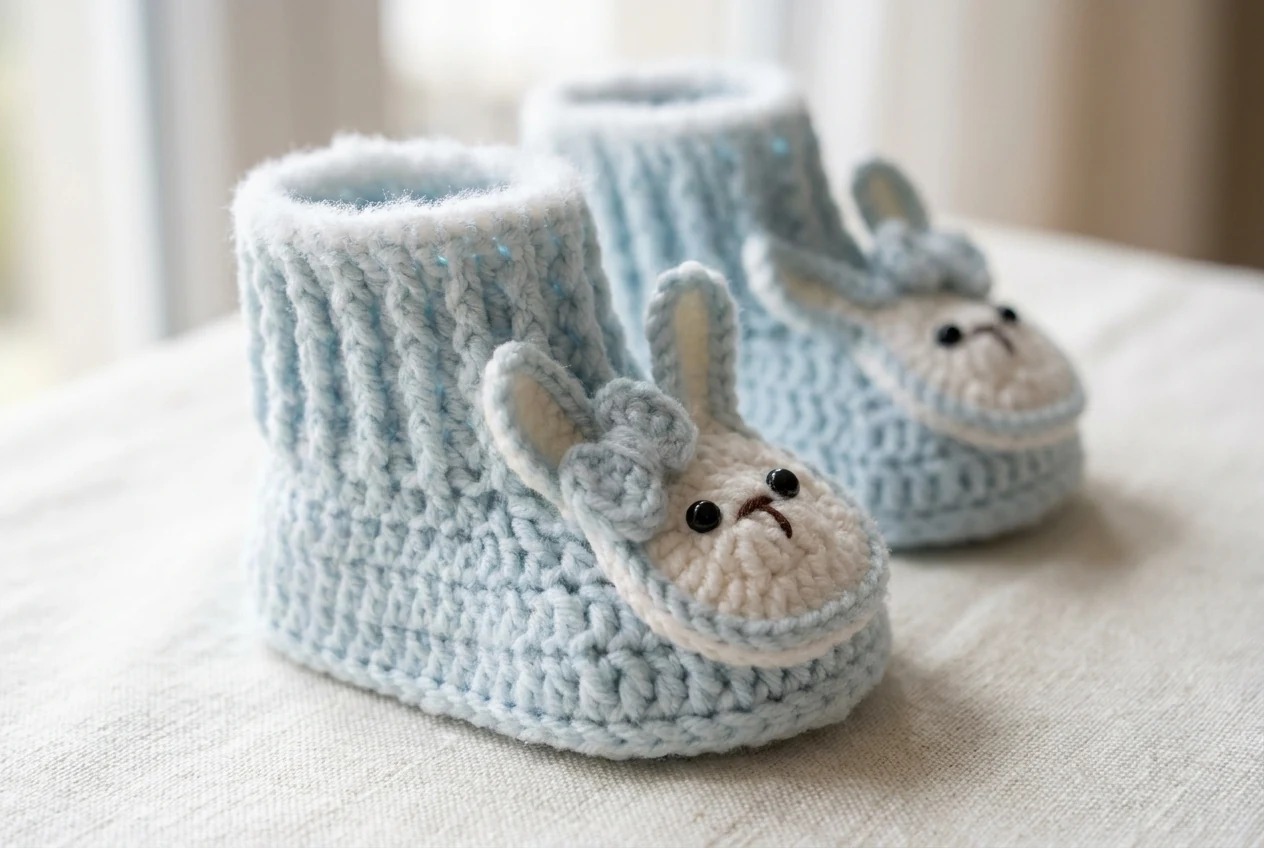
To finish the crochet bunny baby booties pattern, weave tails horizontally through several stitches and reverse direction once. Avoid large knots inside the bootie because they can press against delicate skin. Wash gently with a baby-safe product and dry flat around a soft form, checking that the two cuffs remain the same height.
The source adds a 60-chain tie. If you include it, secure it permanently and evaluate the finished length carefully. A decorative tie should never form a loose loop around a baby’s ankle or toes.
Baby Safety
The crochet bunny baby booties pattern is intended for supervised decorative wear, so complete the following checks:
- Embroider eyes and facial details instead of using detachable beads or safety eyes.
- Check the applique, ears, bow, and tie before every use.
- Keep long ties short and supervised.
- Use the booties for warmth and photos, not as non-slip footwear for standing or walking.
- Remove booties if they leave marks, restrict movement, or feel too warm.
Troubleshooting
My sole curls
A slight cup after the upper begins is expected, but the completed sole rounds should lie mostly flat. Curling usually means skipped increases, tight chain stitches, or a hook that is too small.
The sole ruffles
Ruffling means the end curves have too many stitches for your tension. Recheck the Round 1 clusters and Round 2 increases. Do not steam acrylic aggressively to force it flat.
My toe is pointed
Spread decreases across the exact center section instead of stacking all of them in one spot. Mark the center front before beginning each shaping round.
The cuff does not stretch
Front-post stitches may be too tight. Lift each loop to normal double-crochet height and avoid pulling the yarn after inserting around the post.
One bunny face sits crooked
Draw a temporary center line with removable thread, align the nose with the toe center, and pin top, bottom, left, and right before sewing.
FAQ
Open a question to see the answer. These notes cover sizing, materials, modifications, and related pieces.
Final Checklist
- Sole length was measured rather than assumed from age.
- Toe decreases are centered and match on both booties.
- Cuffs stretch and are the same height.
- Faces are embroidered and securely sewn.
- No hard knots or loose ends remain inside.
A careful count and parallel construction make this crochet bunny baby booties pattern much easier to finish as a matching pair. Measure the soles early, compare the shoes often, and prioritize a soft, safe interior.