4 Essential Safety and Sizing Tips for Crochet Baby Clothes Patterns
Crochet baby clothes pattern safety is not about fear; it is about preparation, honest claims, and careful finishing. The Daisy Garden Baby Set PDF supplies gauge, finished measurements, attachment instructions, and a clear drawstring warning. The maker is responsible for applying those details, inspecting the garment, and supervising use.
This guide uses the supplied pink-and-white sample as a concrete case study. The phrase crochet baby clothes pattern safety describes the article’s planning focus; it is not a certification or promise. Always verify fit, yarn behavior, and finishing choices for the specific recipient.
In this article
Tip 1: Select Size by Finished Measurements, Not Age Alone
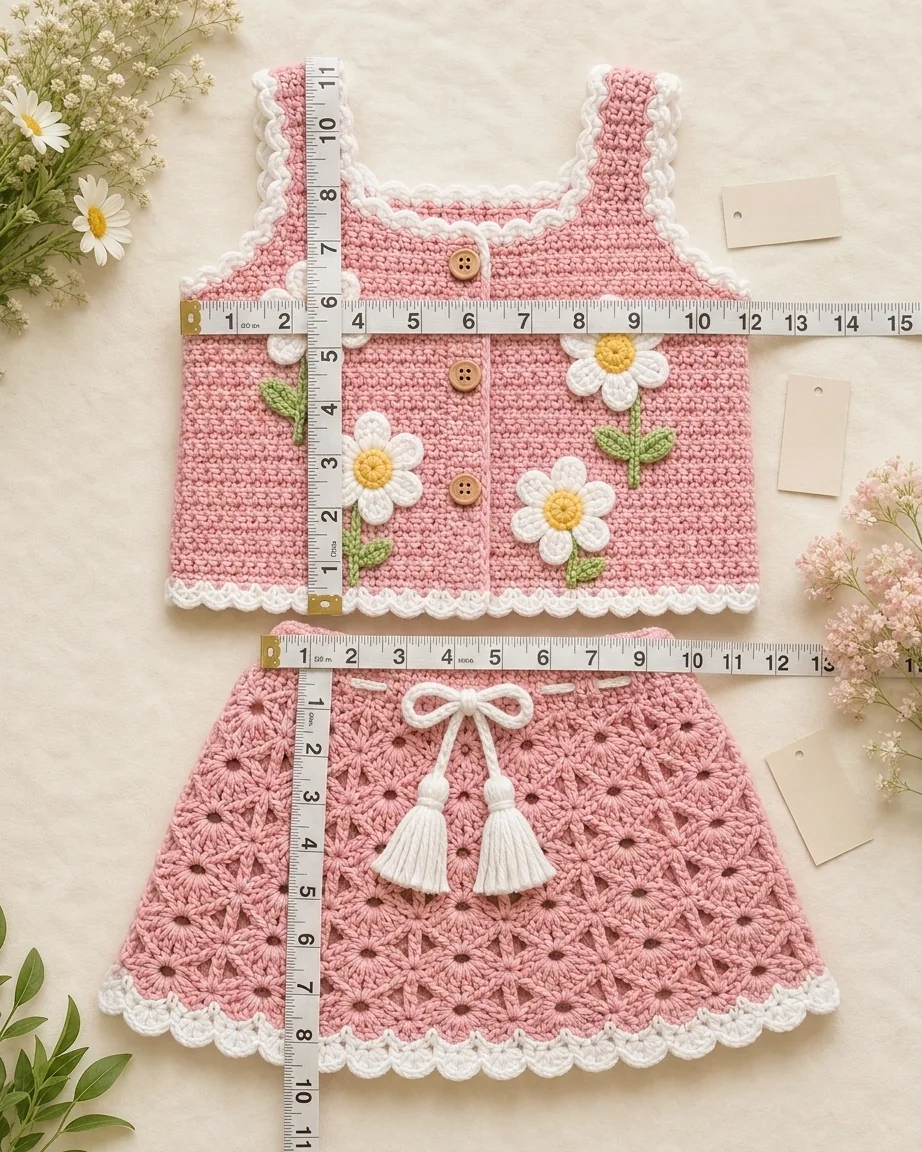
Crochet baby clothes pattern safety begins with fit planning. The PDF lists top chest measurements of 52, 56, and 60 cm; top lengths of 24, 26, and 28 cm; relaxed skirt waists of 44, 46, and 48 cm; and skirt lengths of 25, 27, and 29 cm. Compare these with a current garment or reliable body measurements rather than choosing only from age labels.
Allow for the intended wearing ease, diapering needs, and seasonal layers, but do not invent ease values the pattern does not specify. A blocked gauge swatch is essential because an apparently small difference per 10 cm compounds across the garment.
Work slowly enough to inspect responsible finishing in good light. Count at the end of each repeat, compare both sides before continuing, and place a removable marker wherever a shaping decision must be mirrored. This small pause is faster than undoing several rows later. Keep notes for the size you selected, including hook changes, blocked gauge, yarn use, and any intentional color substitutions.
The photographs in this article are independently generated instructional references rather than cropped pages from the PDF. Use them to understand the stage and orientation, but let the official written pattern control exact stitch placement. Handmade tension varies, so your fabric may look slightly different while still matching the required blocked measurements.
crochet baby clothes pattern safety planning note
Photograph or note your choices for responsible finishing before changing the project. Keep the original pattern counts separate from personal edits, and make only one controlled change at a time. That record makes matching, gifting, and future remakes much easier.
Tip 2: Secure All Notions Firmly
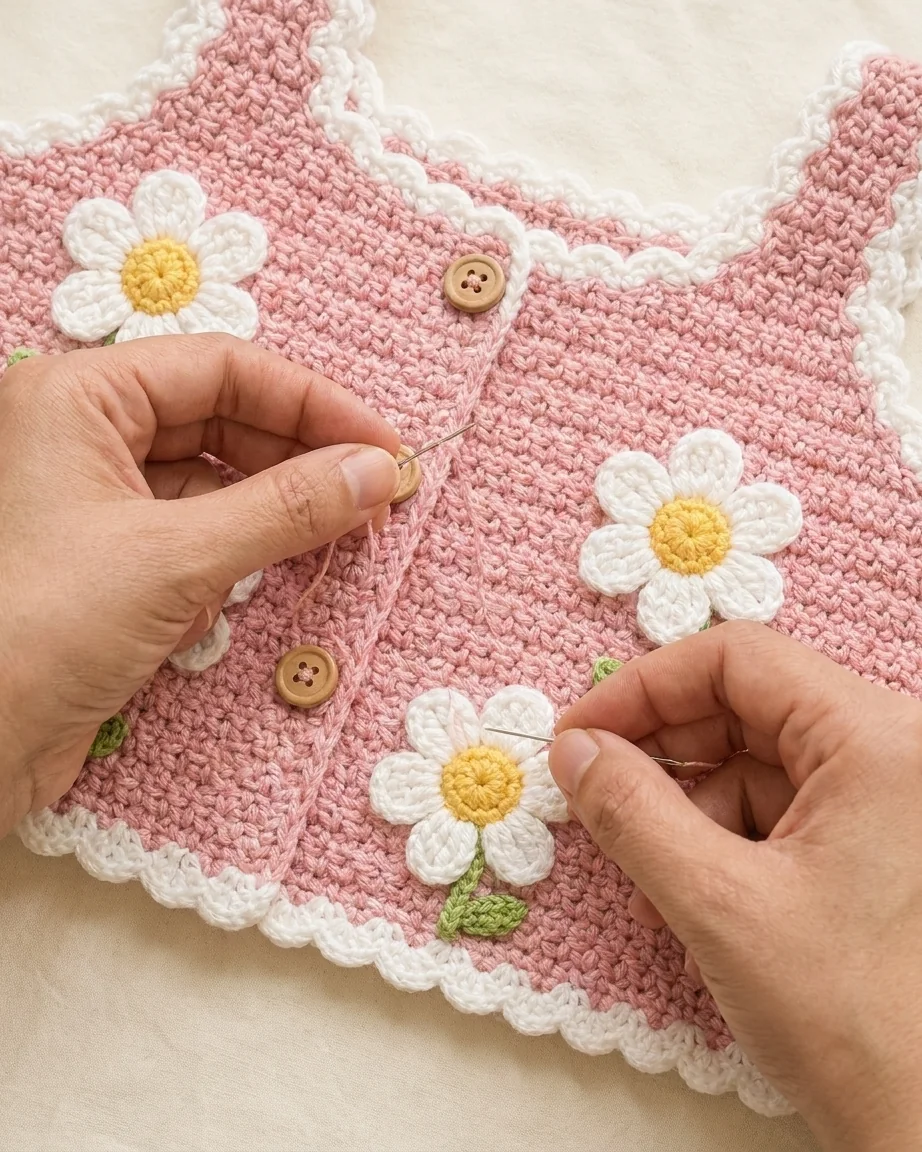
Sew each 15 mm wooden button through stable fabric with secure thread or yarn appropriate to the notion. After blocking, align the bands, sew the buttons opposite the holes, and pull-test them. Inspect before every wear because fibers and knots can change with laundering and use.
Treat the flowers as notions too. Sew every petal, yellow center, stem, and leaf edge, weave tails in multiple directions, and check for lifting edges. These steps reduce obvious loose parts but do not create a safety certification.
Work slowly enough to inspect responsible finishing in good light. Count at the end of each repeat, compare both sides before continuing, and place a removable marker wherever a shaping decision must be mirrored. This small pause is faster than undoing several rows later. Keep notes for the size you selected, including hook changes, blocked gauge, yarn use, and any intentional color substitutions.
The photographs in this article are independently generated instructional references rather than cropped pages from the PDF. Use them to understand the stage and orientation, but let the official written pattern control exact stitch placement. Handmade tension varies, so your fabric may look slightly different while still matching the required blocked measurements.
crochet baby clothes pattern safety planning note
Photograph or note your choices for responsible finishing before changing the project. Keep the original pattern counts separate from personal edits, and make only one controlled change at a time. That record makes matching, gifting, and future remakes much easier.
Tip 3: Treat Drawstrings with Extra Caution
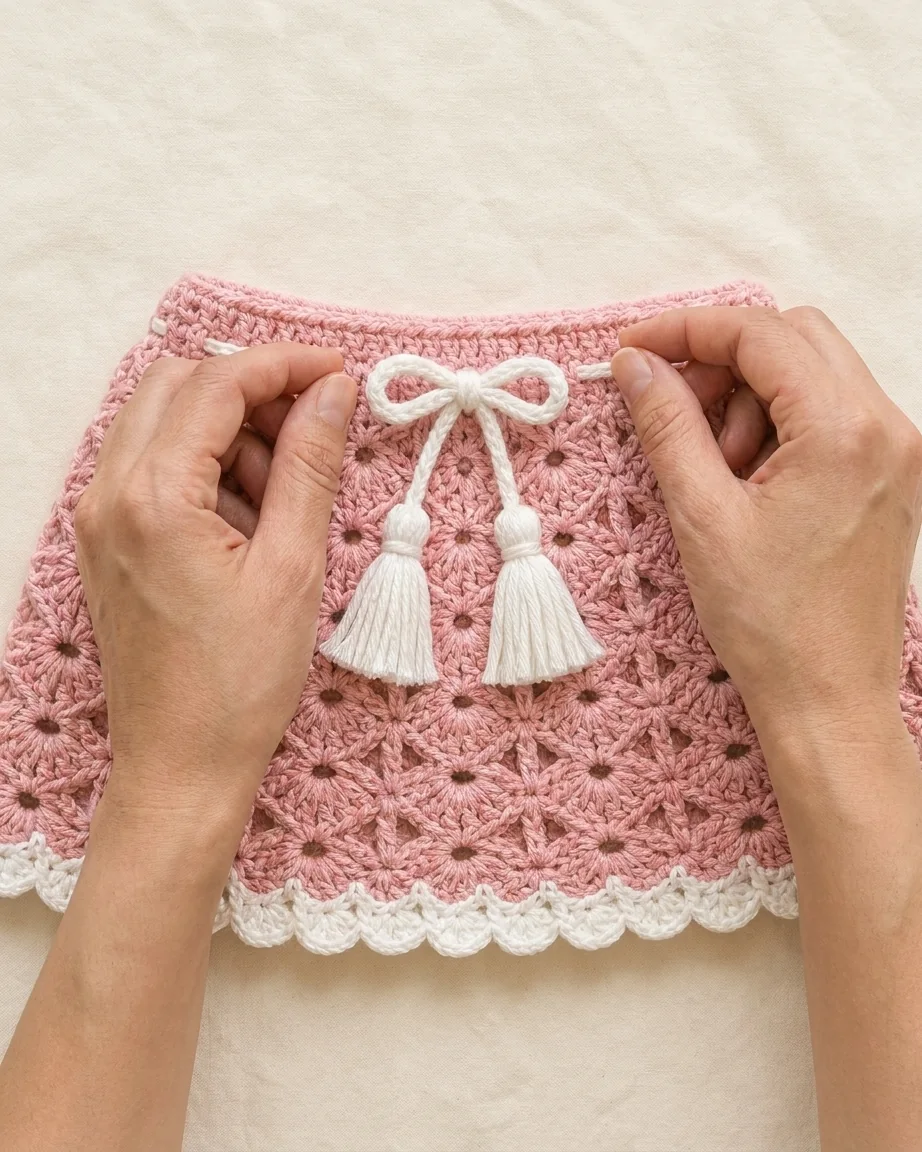
The supplied PDF explicitly says that drawstrings require close adult supervision and must never be worn during sleep. Keep the cord ends short, secure both tassels, and check that the waistband channel does not allow excessive movement. Remove the drawstring for sleep.
A maker may omit the cord completely. If doing so, confirm that the relaxed waistband measurement provides the intended fit; do not replace it with elastic, ribbon, snaps, or another closure without independently assessing construction and suitability.
Work slowly enough to inspect responsible finishing in good light. Count at the end of each repeat, compare both sides before continuing, and place a removable marker wherever a shaping decision must be mirrored. This small pause is faster than undoing several rows later. Keep notes for the size you selected, including hook changes, blocked gauge, yarn use, and any intentional color substitutions.
The photographs in this article are independently generated instructional references rather than cropped pages from the PDF. Use them to understand the stage and orientation, but let the official written pattern control exact stitch placement. Handmade tension varies, so your fabric may look slightly different while still matching the required blocked measurements.
crochet baby clothes pattern safety planning note
Photograph or note your choices for responsible finishing before changing the project. Keep the original pattern counts separate from personal edits, and make only one controlled change at a time. That record makes matching, gifting, and future remakes much easier.
Tip 4: Block and Inspect Before Use or Gifting
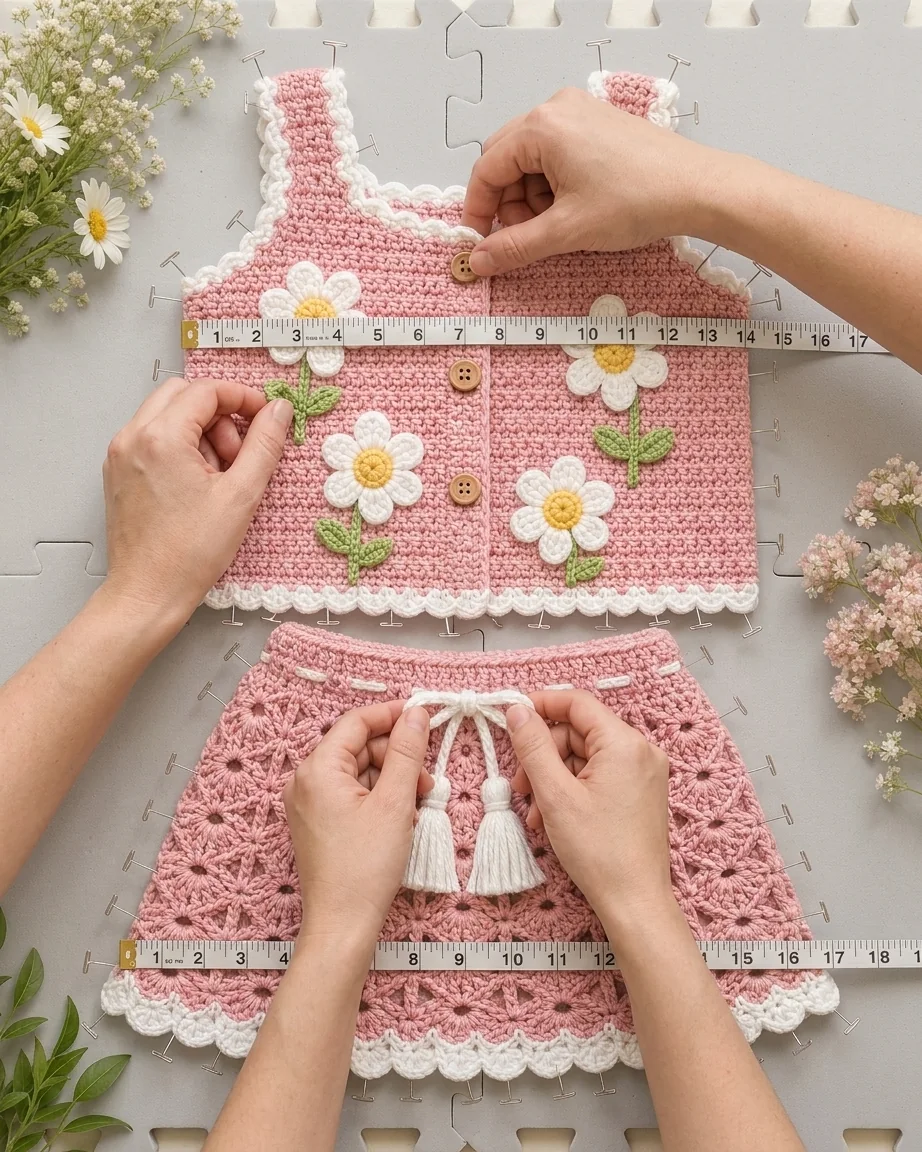
Block both pieces separately according to the yarn label. Pin the white scallops open, shape without overstretching, and dry completely. Measure chest, top length, relaxed waist, and skirt length after drying because that is the state compared with the finished chart.
Inspect seams, yarn tails, buttons, flowers, leaves, cord, and tassels. Pull-test attachments and recheck after laundering. The pattern also notes that all three sizes and shell gauge still require physical verification, so do not describe the design as fully tested until that work is documented.
Work slowly enough to inspect responsible finishing in good light. Count at the end of each repeat, compare both sides before continuing, and place a removable marker wherever a shaping decision must be mirrored. This small pause is faster than undoing several rows later. Keep notes for the size you selected, including hook changes, blocked gauge, yarn use, and any intentional color substitutions.
The photographs in this article are independently generated instructional references rather than cropped pages from the PDF. Use them to understand the stage and orientation, but let the official written pattern control exact stitch placement. Handmade tension varies, so your fabric may look slightly different while still matching the required blocked measurements.
crochet baby clothes pattern safety planning note
Photograph or note your choices for responsible finishing before changing the project. Keep the original pattern counts separate from personal edits, and make only one controlled change at a time. That record makes matching, gifting, and future remakes much easier.
A careful crochet baby clothes pattern safety plan also records gauge, measurements, materials, and every intentional modification before publication or gifting.
A careful crochet baby clothes pattern safety plan also records gauge, measurements, materials, and every intentional modification before publication or gifting.
A careful crochet baby clothes pattern safety plan also records gauge, measurements, materials, and every intentional modification before publication or gifting.
Practical Planning Notes
When gifting, include care information from the actual yarn label and explain every removable-looking feature. Share the guide to gifting a handmade baby pattern responsibly and review the design details that support careful finishing. Keep a record of the selected size, blocked gauge, yarn, and inspection date.
Work slowly enough to inspect the final plan in good light. Count at the end of each repeat, compare both sides before continuing, and place a removable marker wherever a shaping decision must be mirrored. This small pause is faster than undoing several rows later. Keep notes for the size you selected, including hook changes, blocked gauge, yarn use, and any intentional color substitutions.
The photographs in this article are independently generated instructional references rather than cropped pages from the PDF. Use them to understand the stage and orientation, but let the official written pattern control exact stitch placement. Handmade tension varies, so your fabric may look slightly different while still matching the required blocked measurements.
Frequently Asked Questions
Can I replace buttons with snaps?
That would be a personal modification not specified in the supplied pattern. Assess the snap type, attachment method, fabric stability, and recipient needs independently.
Can I remove the drawstring?
Yes. Confirm the relaxed waistband fit and do not substitute another closure without evaluating it. Removing the cord is especially relevant for sleep.
Does careful finishing make the garment certified safe?
No. Secure finishing and inspection are responsible practices, not a certification or guarantee.
Final Checklist
- ✓ Choose size from finished measurements, not age alone.
- ✓ Block and remeasure both pieces.
- ✓ Pull-test buttons, flowers, leaves, and tassels.
- ✓ Shorten and supervise the drawstring; remove it for sleep.
- ✓ Do not claim certification or fully tested status without evidence.
Ready to crochet the Daisy Garden set?
Use this article as your planning companion, then follow the complete illustrated pattern for the row-by-row instructions and size-specific counts.