
My Crochet Universe · Pocket Panda series
Crochet Bag Charm: 1 Easy Panda for the Biggest Bag Trend
A practical, image-rich guide for crocheters who want a polished result.
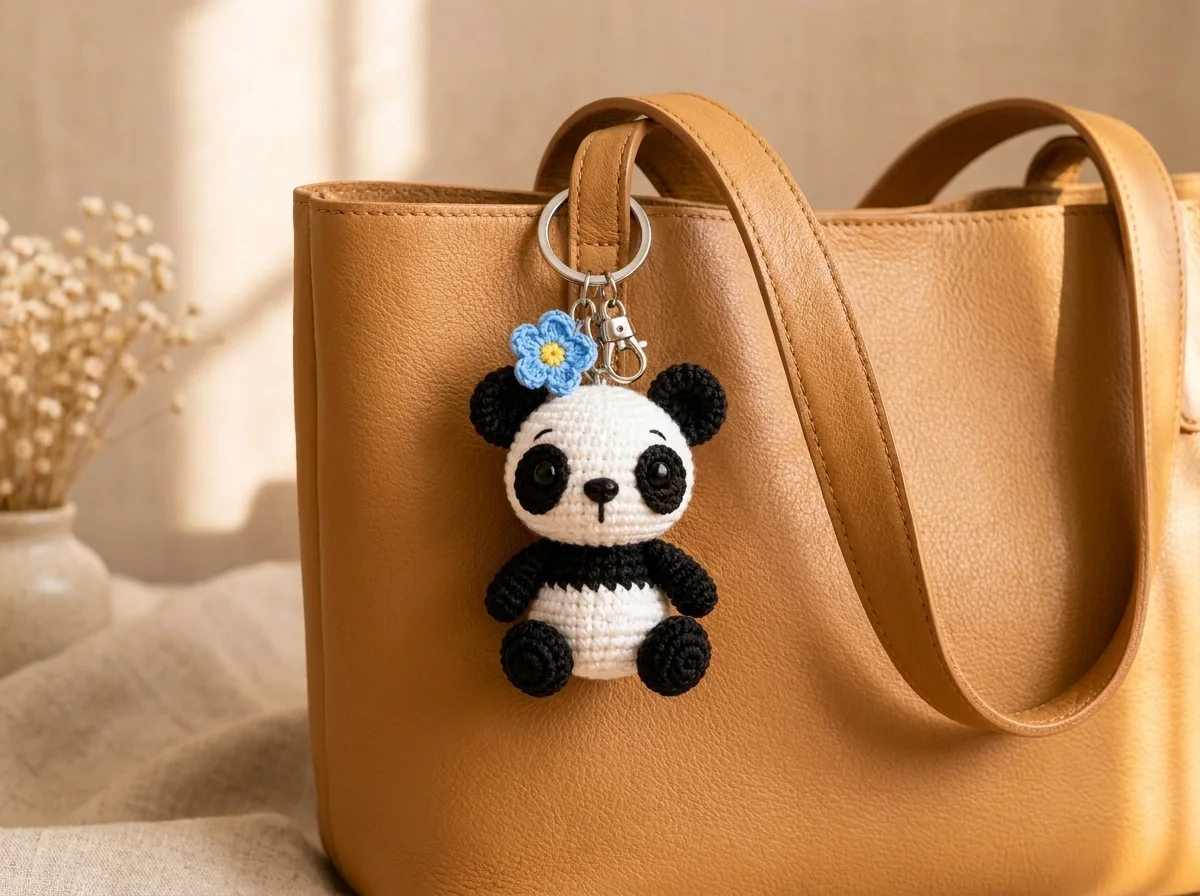
The tiny accessory with a big job
A crochet bag charm works best when the silhouette remains readable from several steps away.
The best bag accessories do two things at once: they make someone smile, and they make the bag easy to recognize. A plain tote becomes personal with one small detail hanging from the handle. A backpack becomes easier to spot in a crowded room. A keyring becomes more than hardware when it carries a tiny handmade character.
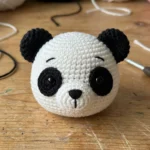
That is exactly why the Pocket Panda works so well as a crochet bag charm. At approximately 8–10 cm, it is small enough to carry every day but large enough to show its face, black eye patches, rounded paws, and blue flower accent. It feels like a finished character rather than a random yarn decoration.
So here is the main idea: a well-designed crochet bag charm should be cute, durable, lightweight, and easy to personalize. The Pocket Panda combines all four qualities in one compact project, while the complete PDF pattern gives you the exact instructions needed to build and reinforce it.
Why a panda makes a perfect charm
For daily use, a crochet bag charm needs reinforced joins as much as it needs a cute face.
A bag charm has to work at a small scale. Complicated details disappear, but simple high-contrast shapes remain visible. The Pocket Panda uses a white head and body, black ears and eye patches, and a small blue flower. Those colors create an expression that stays readable even when the panda is hanging from a bag several steps away.
The seated shape also helps. A flat motif can look attractive in a product photo but become difficult to recognize when it twists on a keyring. A small stuffed panda keeps its volume and gives the charm a front, a back, and a clear silhouette.
The blue flower adds another advantage: it creates a focal point near the keyring. You can keep it blue for the original look, or replace it with pink, yellow, lavender, or a favorite team color.
What makes this more than a basic keychain
The flower lets one crochet bag charm coordinate with many different bags.
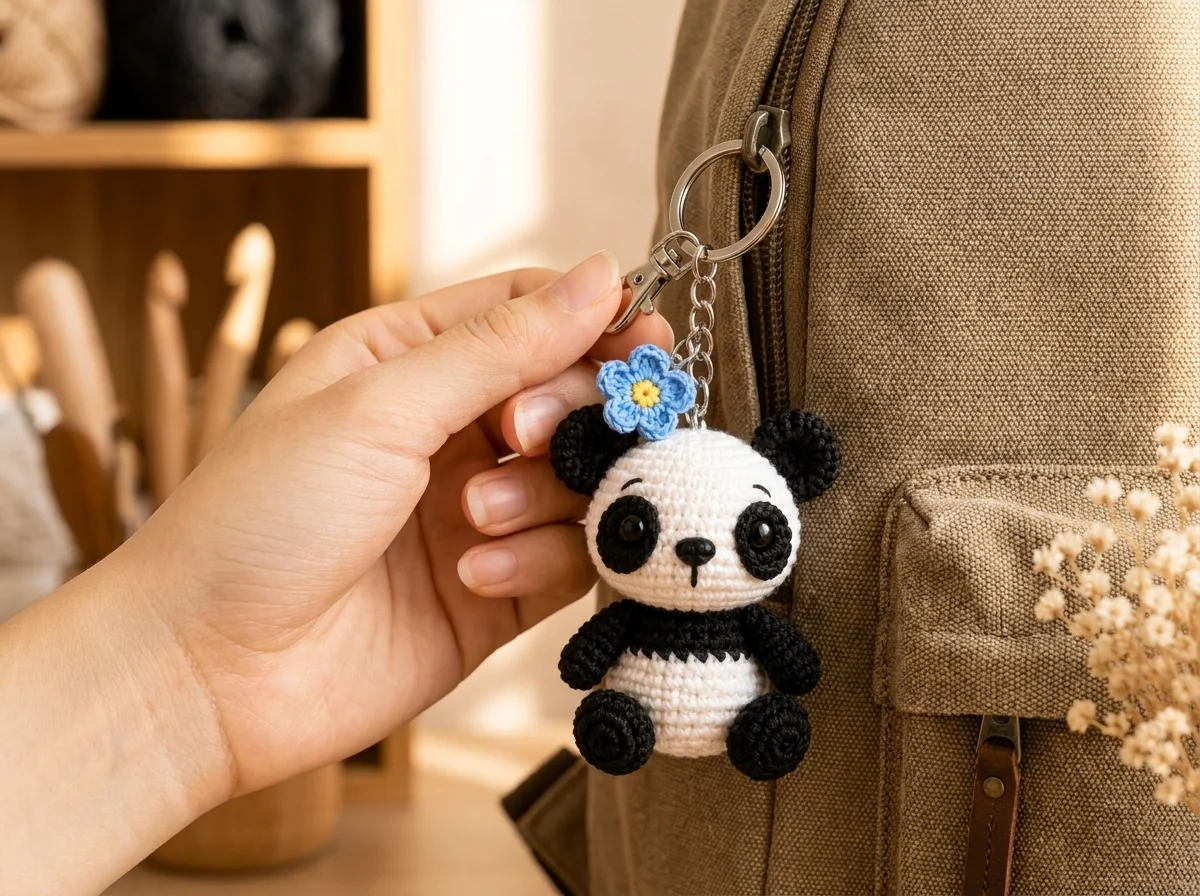
A basic keychain is often treated as a tiny version of a larger amigurumi. That approach can create a problem: too many parts, too much stuffing, and weak attachment points. A useful crochet bag charm needs to be designed for handling from the beginning.
The Pocket Panda pattern includes a compact head, body, ears, eye patches, muzzle, arms, legs, flower charm, and reinforced hardware attachment. The small parts are not merely decorative; they help create a recognizable panda without making the project unnecessarily bulky.
The keyring connection matters just as much as the face. A charm gets pulled, bumped, and twisted. The PDF instructions explain how to pass yarn through several nearby head stitches, reinforce the chain connection, and test the finished join before using it.
A small project with a clear workflow
A finished crochet bag charm should hang straight after the clasp is attached.
The project is written for an adventurous beginner, but the label does not mean you should rush. The most reliable workflow is simple:
- Prepare the yarn, hook, markers, needle, stuffing, and hardware before starting.
- Work the head and body in continuous rounds, marking the first stitch.
- Make the flat ears and eye patches with matching shapes.
- Stuff the body firmly enough to hold its seated form.
- Complete the face before the final assembly.
- Attach the flower and keyring only after checking the balance.
The full PDF contains the exact rounds and stitch counts. On the website, this overview helps readers understand the project before deciding whether it matches their skill level.
The objection: “Won’t it break on my bag?”
Before gifting a crochet bag charm, test every metal and yarn connection firmly.
That concern is reasonable. A decorative object for a shelf does not experience the same stress as a charm attached to a backpack. The answer is reinforcement, not wishful thinking.
Use long sewing tails where the pattern recommends them. Pass the needle through multiple stitches instead of relying on one loop. Reinforce the base of the ears, arms, and legs. At the hardware connection, tug firmly before trimming the ends. If a join shifts during the test, strengthen it before the panda leaves your workspace.
The second important decision is age labeling. Safety eyes, jump rings, clasps, and chain links are small parts. This finished keychain is not suitable for children under three, even if the crochet body feels soft.
Three ways to personalize your charm
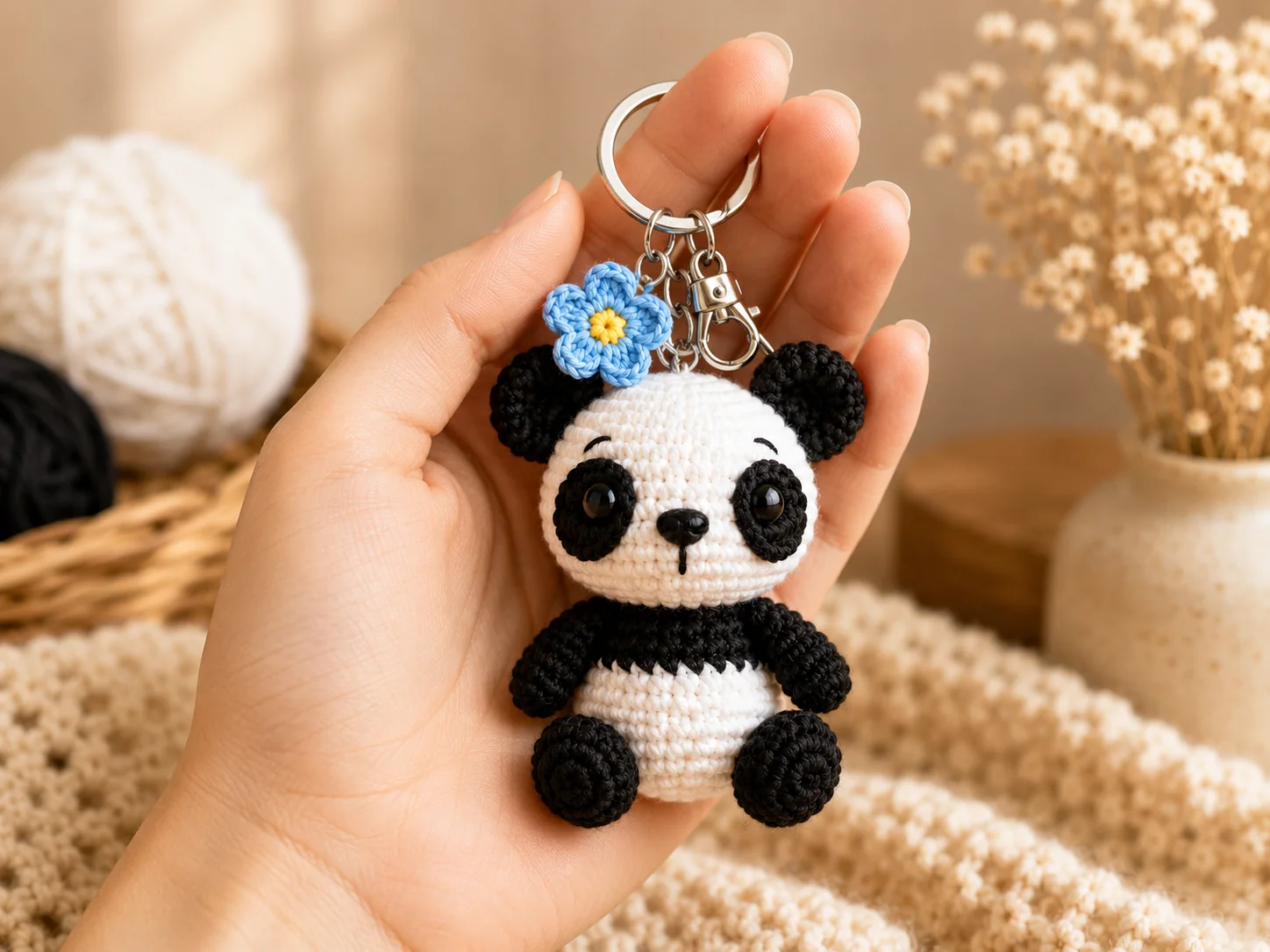
The original design uses a blue flower, but the base panda gives you room to create variations:
- Change the flower to pink for a soft, giftable version.
- Use a yellow or red flower for a brighter everyday charm.
- Create a matching pair by using two flower colors for two bags or two friends.
Keep the panda colors high contrast if you want the face to remain clear. Small accessories are most effective when they support the character rather than cover it.
A practical finishing checklist
Before attaching the charm to a bag, check these points:
- The head and body are firmly joined.
- The safety eyes are secure, or the eyes are embroidered for a child-free decorative version.
- The eye patches and muzzle are symmetrical.
- The flower is attached to the chain, not loosely hanging from one yarn loop.
- The jump ring and clasp do not pull against a single stitch.
- All tails are woven in and hidden.
- The finished panda measures approximately 8–10 cm excluding hardware.
Conclusion
The best crochet bag charm is not the biggest or most complicated one. It is the one that stays recognizable, survives daily use, and gives its owner a reason to smile every time they reach for the bag.
The Pocket Panda pattern gives you the complete roadmap: exact rounds, construction guidance, face placement, flower variation, hardware attachment, and safety information. Get the full PDF on Etsy and make a panda that belongs on your favorite bag. [Etsy pattern link — set to nofollow]
Small enough to carry. Special enough to keep.
Helpful answers
Frequently asked questions
Is a crochet bag charm strong enough for everyday use?
A crochet bag charm can handle normal daily use when every seam is reinforced, the jump ring spreads strain across several stitches, and the clasp is tug-tested before use. Avoid hanging heavy keys from the soft crochet body.
How large is the finished panda charm?
The finished panda measures about 8–10 cm or 3–4 inches, excluding the keyring hardware. That compact size keeps the crochet bag charm visible without making a tote or backpack feel bulky.
Can I change the flower color?
Yes. Keep the black-and-white panda contrast, then personalize the flower with blue, pink, yellow, lavender, or a recipient’s favorite color.
Is this project suitable for a beginner?
It suits an adventurous beginner who is comfortable with single crochet, increases, decreases, continuous rounds, stuffing, and basic sewing. The full PDF organizes the construction into 12 concise steps.
Is the finished charm safe for young children?
No. Safety eyes and metal keyring parts are choking hazards, so the finished item is not suitable for children under three. Embroidered eyes remove one hazard but not the small metal hardware.