
Heirloom Baby Dress: 1 Honest Guide to a Forever Keepsake
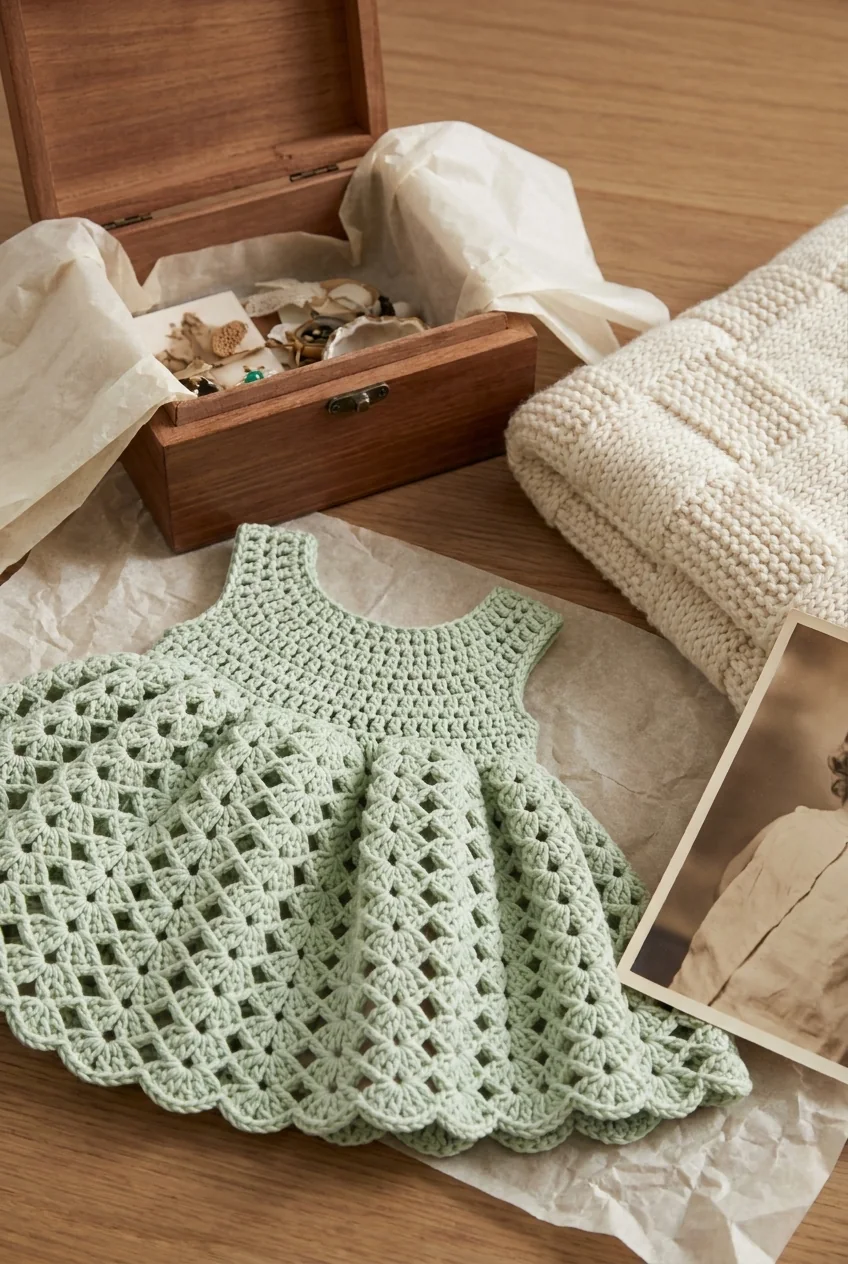
Every baby generates a mountain of stuff, and every parent eventually faces the same quiet triage: what goes to the donation bag, and what goes in the box? The box is small. Almost nothing makes the cut. But almost every family has one — the outfit, the booties, the hat from the hospital photo — the things they couldn’t let go of.
This guide is about how a single hand-crocheted heirloom baby dress earns its place in that box — and how to make one deliberately, so it survives not just this baby, but the next generation’s.
Why Some Things Get Kept
Parenthood moves at a savage pace. The newborn stage lasts about fifteen minutes; the 3–6 month size gets worn three times. Objects that can’t keep up get passed along, and honestly, most of them should be. Practical things are meant to be used up.
But a few objects get promoted from used to kept, and it never happens by accident. Look inside any family’s memory box and you’ll find the same three ingredients: the object was present at a moment that mattered, it was made or chosen specifically for that child, and it has a story attached that someone still tells.
My argument, in one sentence: you cannot schedule the moments, but you can absolutely build the object — and a hand-crocheted heirloom baby dress, made from the right yarn in the right way with the story written down, is the single most reliable keepsake a maker can create.
The Anatomy of a Keepsake
Myth: things become keepsakes by age. Reality: things become keepsakes by association — and association can be designed. Here’s the anatomy:
- Presence: the dress should be there at the documented moments — the coming-home day, the first portrait, the first family gathering. Keepsakes are witnesses.
- Specificity: made for this baby, in a color chosen for a reason. “Sage, because it matched the nursery her grandmother painted” is the kind of sentence that gets retold for decades.
- Craft that lasts: this is where crocheters hold all the cards, because handmade can be engineered for longevity in a way fast fashion never will.
The Madeleine dress happens to be built like a keepsake by default: a vintage lace silhouette that won’t date, tiny dimensions that fit any memory box, and a stitch pattern that has looked elegant since your grandmother’s era and will look elegant at your granddaughter’s.
The Memory Box Formula
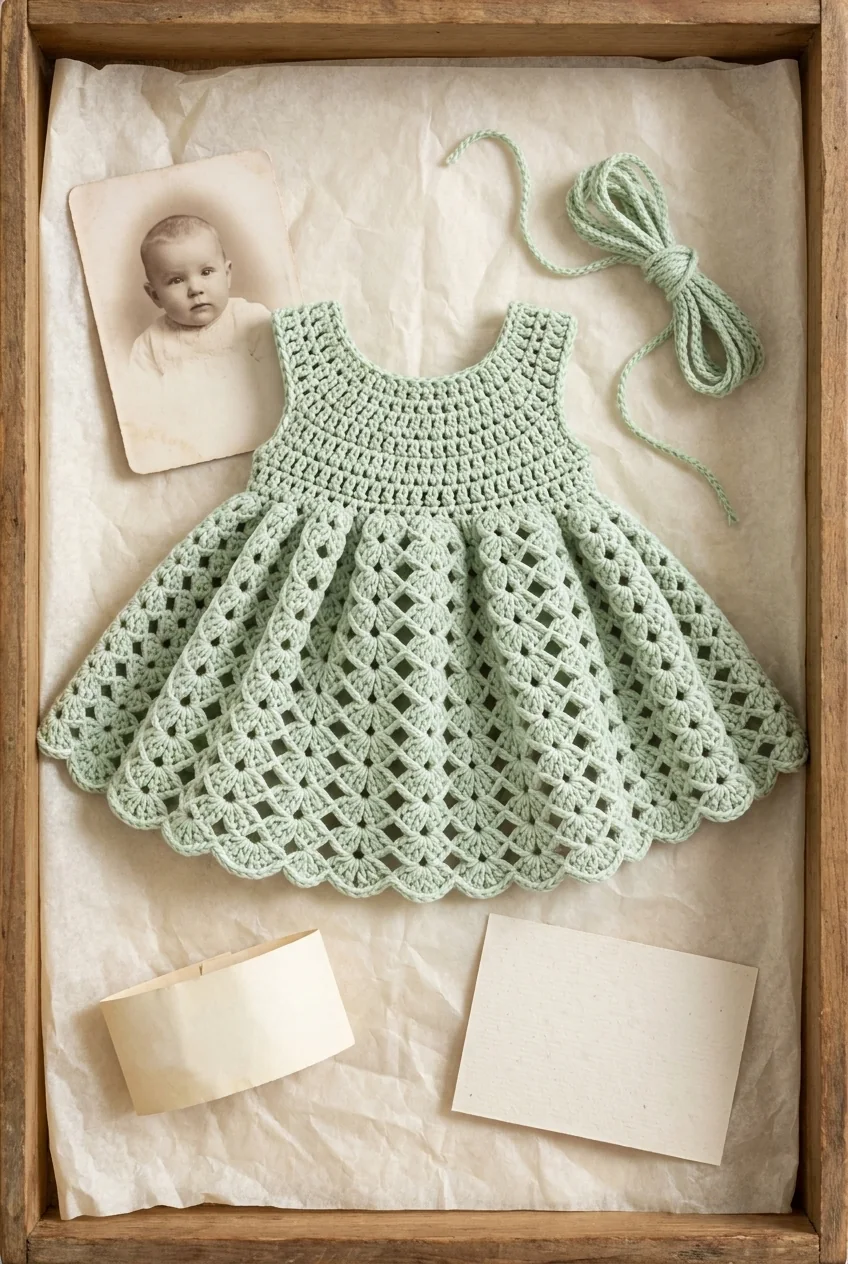
A keepsake isn’t just the object — it’s the object plus its archive. Here’s the complete formula:
- The dress, washed gently before storing, fully dry, folded in acid-free tissue
- One photo of baby wearing it, printed — not just on a phone that dies in a decade
- The yarn label and a snip of leftover yarn, taped to a card
- The story card: who made it, when, for whom, and why the color was chosen. Three sentences. This card is what separates “old baby dress” from “family heirloom”
Story one. My grandmother kept a knitted matinee jacket — hers, from 1950-something — in a hatbox with a note in her own handwriting. That note is why the jacket survived three house moves and a garage clear-out. The wool was nice. The handwriting was priceless. Your story card is your handwriting.
Story two. A friend made the Madeleine in cream for her daughter’s first portraits, then did the smartest thing I’ve seen: she made a second, identical one. One got worn, photographed, loved hard. The other went straight into the box, unworn, pristine. Two skeins of yarn — one for the memories, one for the archive. Total extra cost: about six dollars.
“Isn’t It Silly to Keep Clothes?”
Objection one: “It’s just a dress. Babies outgrow everything.” Exactly — and that’s the point. The speed of it is precisely why we keep things: the dress is the proof that the fifteen-minute newborn stage actually happened. Nobody keeps the things that lasted. We keep the things that didn’t.
Objection two: “I’m making this for someone else’s baby — isn’t the memory box the parent’s job?” It is — and that’s your opportunity. When you gift the dress with the story card already written and a spare snip of yarn included, you’re not just giving a garment; you’re handing the parents a pre-assembled heirloom. Of every handmade baby gift I’ve tracked, the ones with a written note are the ones that stay. Handmade Baby Shower Gift
And for the practical crocheter asking the practical question — won’t a worn, washed dress fall apart? Not if you build it like an heirloom: smooth, tightly-plied cotton or premium baby acrylic Best Yarn For Baby Clothes, woven-in ends (never just knotted), and gentle washing. Construction choices now are what the dress is made of in thirty years. textile care and preservation basics
Your Keepsake Checklist
- Choose a classic colorway (sage, cream, dusty rose) — trends date, classics testify
- Weave every end invisibly; knots are where decades-old garments fail first
- Write the story card the week you finish, while the details are fresh
- Consider the two-dress strategy: one to wear, one to keep
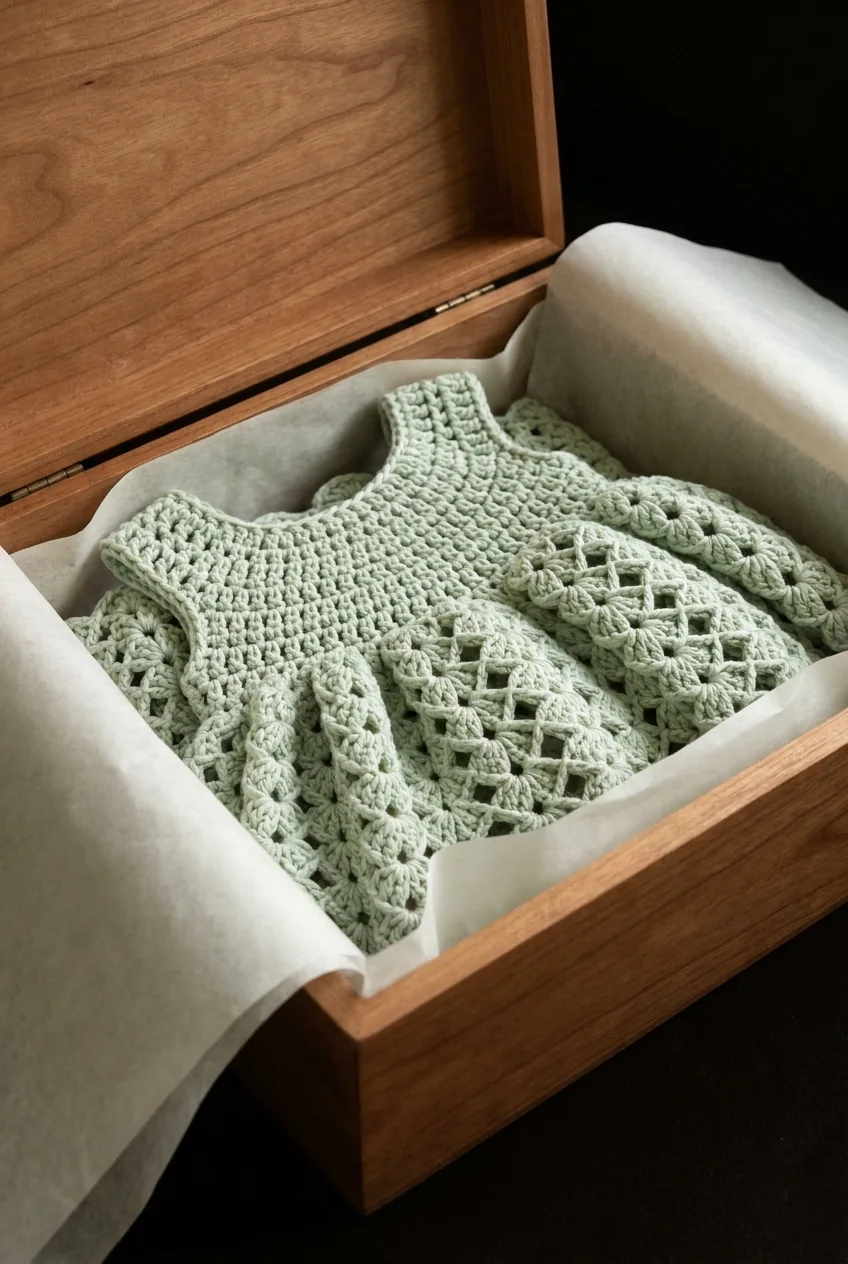
- Store flat, in tissue, away from light — future archivists will thank you
The Long Game
Here’s the scene this is all building toward: some afternoon, decades from now, a grown woman opens a box, lifts out a tiny sage dress, and reads a card in handwriting she’s known her whole life. The dress fits nothing and no one. It will never be worn again. And it is, without any competition, the most important piece of clothing in the house.
That’s what you’re actually crocheting when you start this pattern. Five or six evenings of stitches, and a fifty-year object.
Conclusion
The formula is as honest as it gets: classic color, careful construction, woven ends, one printed photo, one story card, acid-free tissue. Do those things and you’re not making baby clothes — you’re making the artifact a family organizes its memories around.
The Madeleine Baby Dress pattern is in my Etsy shop, sizes 0–24 months, with a full photo guide. Babies are only small once. Make the dress while they still fit it — the box will handle the rest. Get the Madeleine Baby Dress pattern
Clothes get outgrown. Keepsakes get inherited.
Frequently Asked Questions
What makes a dress an heirloom?
An heirloom baby dress becomes meaningful through careful construction, a documented story, photographs and thoughtful storage—not price alone.
How should I store the dress?
Wash and dry the heirloom baby dress completely, wrap it in acid-free tissue, and store it flat in a clean box away from light and moisture.
What should go on the story card?
Record who made the heirloom baby dress, for whom, the date, yarn details and why the color was chosen.
Can the dress be worn before storage?
Yes. Inspect the heirloom baby dress before every wear, supervise the baby, secure the button carefully, and clean and dry it fully before storage.