
Lace Crochet Baby Dress: 5 Proven Tips for Beginners
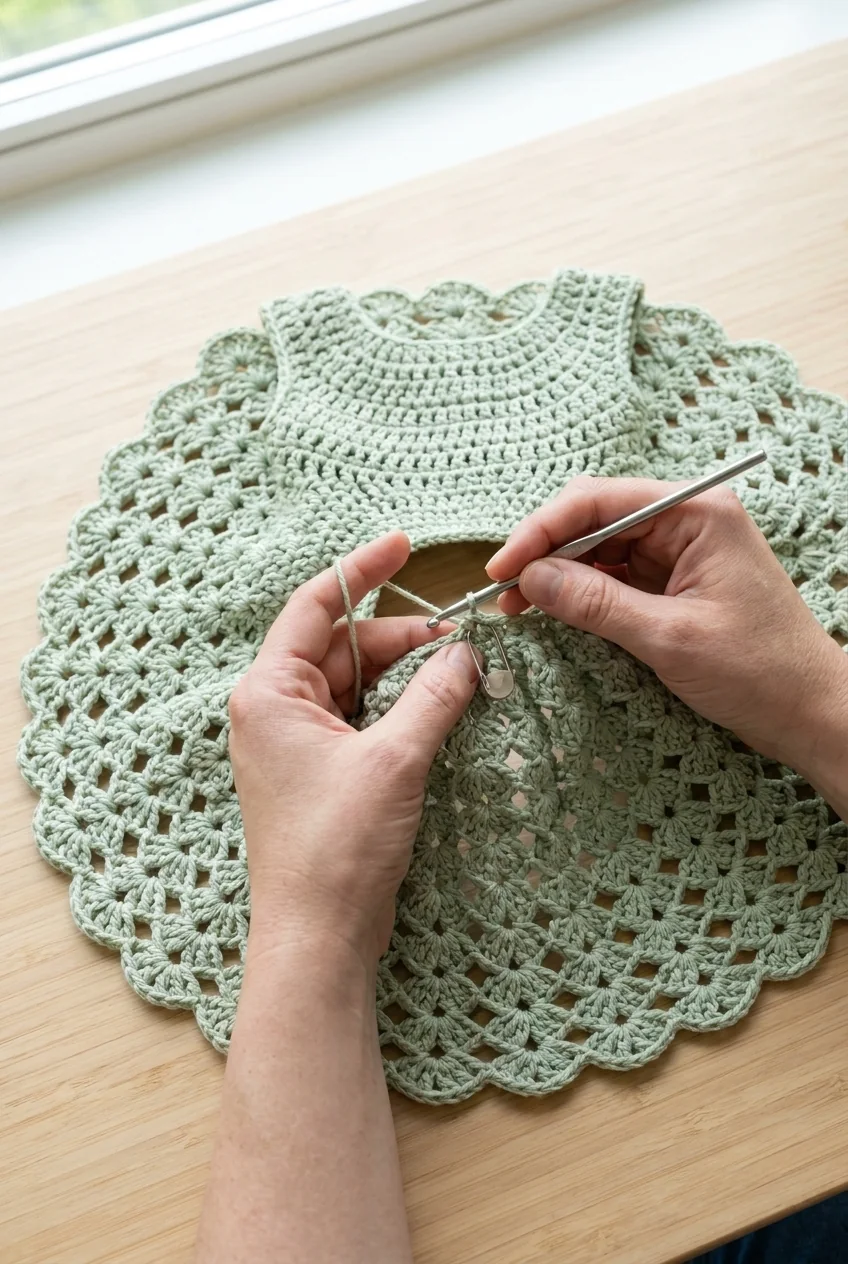
Let me guess. You found the dress — the sage one with the lace skirt that looks like it belongs in a boutique window — and you were already mentally choosing yarn colors when your eyes hit the difficulty rating: Hard. And just like that, the tab got closed.
Come back. Because that rating is describing the wrong thing — and by the end of this guide, you’ll see that a lace crochet baby dress is less a test of skill and more a test of setup.
What “Hard” Actually Means
Pattern difficulty ratings are one of the least helpful numbers in crochet, because they compress everything into one word. A pattern gets marked “Hard” for any of three very different reasons: it uses a stitch you haven’t met yet, it demands sustained counting, or it punishes late mistakes. Notice what’s missing from that list: talent.
The Madeleine dress is the third kind. Its lace skirt is one stitch pattern — a shell/fan repeat — worked over and over on a tiny canvas. “Hard” here doesn’t mean “expert hands.” It means “a beginner who is set up correctly will finish; a beginner who wings it will frog.”
So here is my argument, in one sentence: with five specific preparations — a swatch, a counting system, blocking, the right yarn, and a two-row repair rule — a confident beginner can absolutely finish a lace crochet baby dress, and this guide is those five preparations.
Myth: lace is advanced crochet. Reality: lace is repetitive crochet with a counting requirement. Advanced is cables in the round with color changes. Lace is a rhythm you learn once and then ride.
Tip 1: Learn the Stitch on a Swatch, Not on the Dress
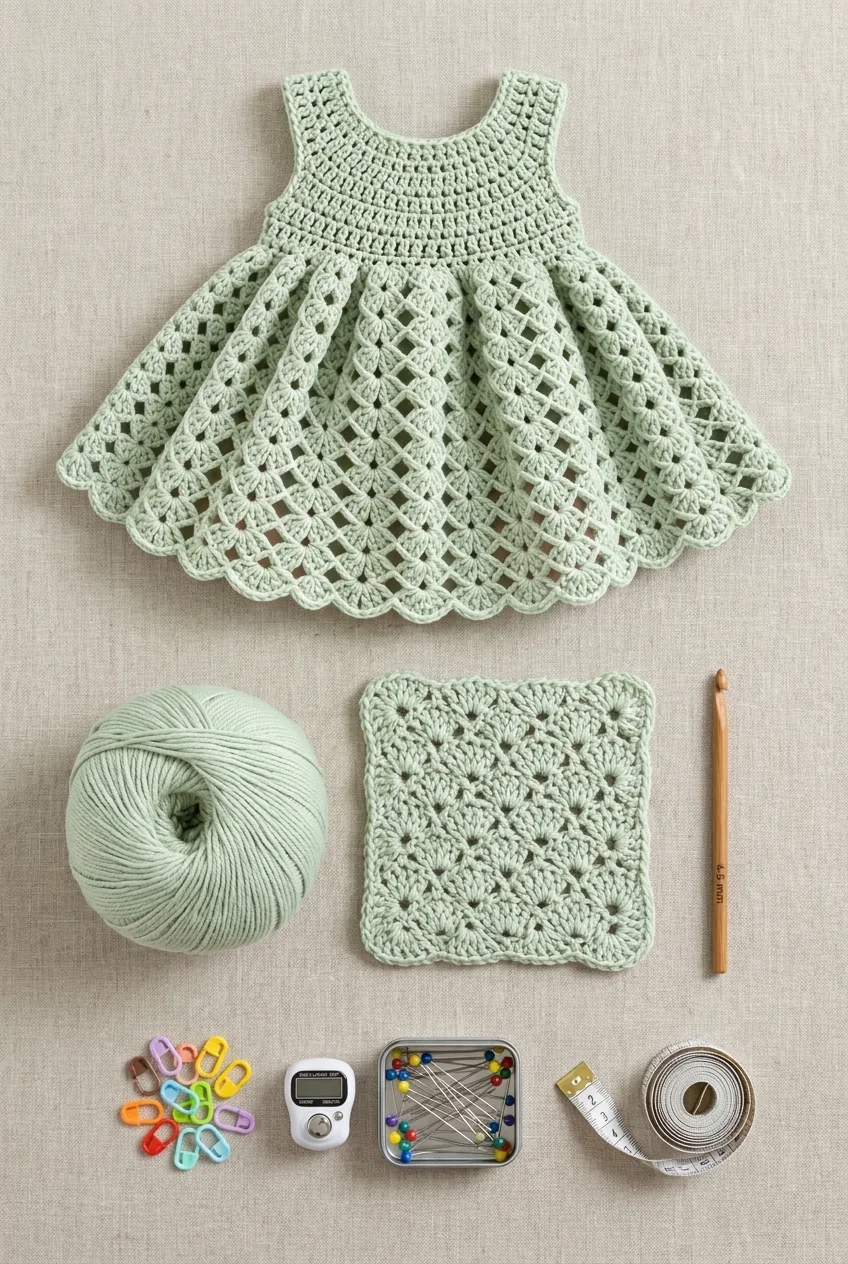
Never meet a new stitch inside a project. Crochet a swatch — twenty chains, four or five repeats of the shell pattern — and make every mistake there first. By the third repeat your hands will find the rhythm; by the fifth, you’ll understand why the shells stack the way they do.
The swatch has a second job: it tells you your fabric. If your shells look tight and pinched, go up half a hook size. Lacy and floppy, go down. Twenty minutes of swatching buys you a dress that fits.
Tip 2: Count the Repeat, Not the Rows
Here’s the beginner’s classic failure with lace: tracking rows, losing count at row eleven, and discovering at row fifteen that something went wrong somewhere. Rows are the wrong unit. The repeat is the right one.
Every shell repeat is a self-checking module: same stitch count in, same stitch count out. Place a stitch marker at the start of each repeat for the first few rounds of the skirt. When a repeat doesn’t check out, the error is inside those few stitches — not somewhere in an anonymous sea of rows. You’ve just turned “find the mistake” into a ten-second task.
Tip 3: Blocking Is Not Optional
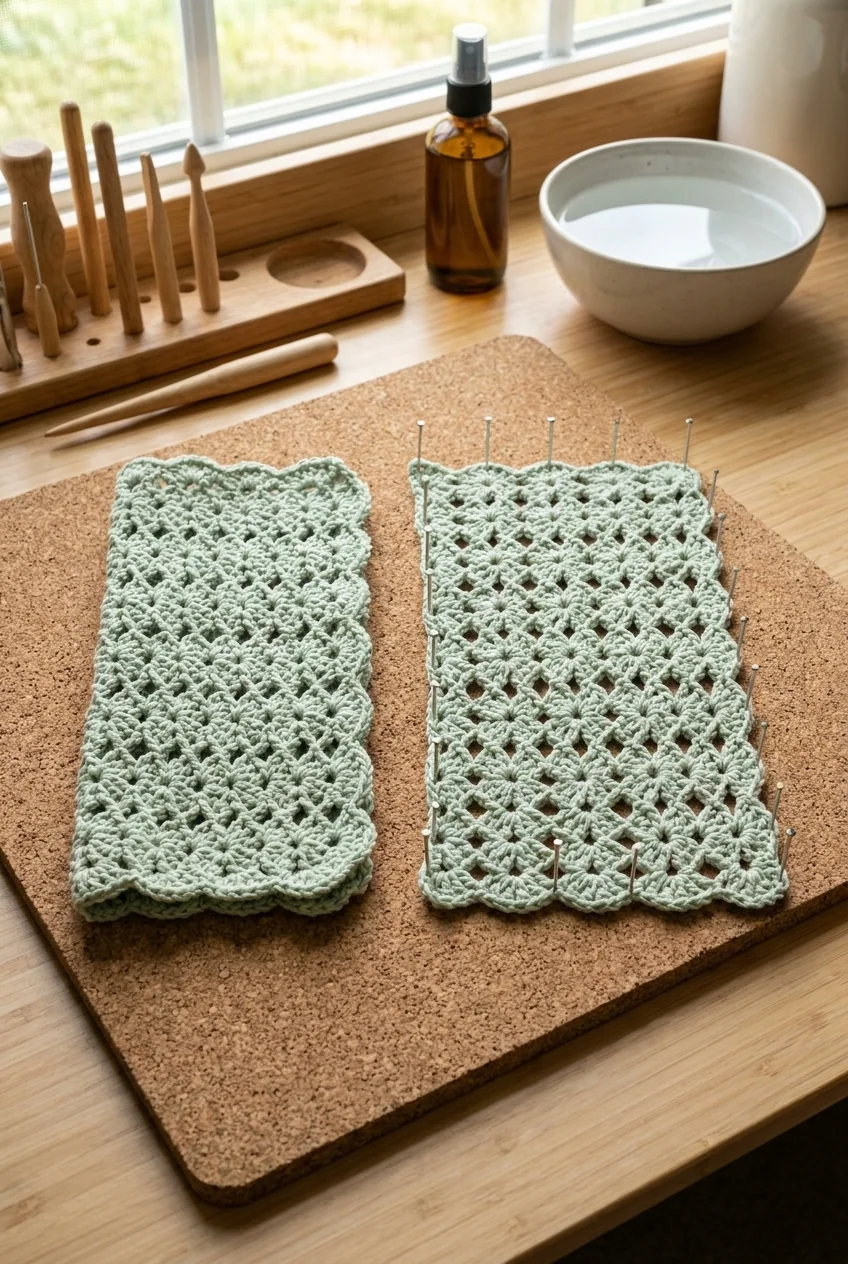
If you take one tip from this entire article, take this one. Unblocked lace looks like a crumpled doily; blocked lace looks like the photos. It’s the same dress — the stitches simply haven’t been opened yet.
The process is genuinely gentle: hand-wash in cool water with a drop of baby-safe detergent, press the water out in a towel (never wring), lay flat, and ease the skirt into shape with your fingers, pinning the shell points if you want them crisp. Overnight dry. The transformation is so dramatic that blocking day is secretly the best day of the whole project.
Tip 4: Choose Forgiving Yarn
For a first lace project, yarn choice is half the difficulty rating. You want a smooth, plied yarn — soft combed cotton or a premium baby acrylic — in a light, solid color. Smooth yarn shows stitch definition; plied yarn survives the inevitable unravels without splitting; light colors let you see your stitches, which matters more than any tutorial.
Save the fuzzy, dark, and single-ply yarns for dress number two. They make lace three times harder to read, and lace you’ve already conquered. standard yarn weight guide
Tip 5: Fix Mistakes Within Two Rows
Adopt this rule as law: never sleep on a suspicion. The moment something feels off — an odd count, a shell that sits funny — stop and check now. In lace, a mistake fixed within two rows is a two-minute event. The same mistake discovered six rows later is a half hour of careful frogging and a small crisis of faith.
The two-row rule is what separates people who finish Hard patterns from people who own three half-finished Hard patterns. It’s not skill. It’s inspection timing.
Two quick stories, because both of these were me. On my first lace baby dress, I skipped the swatch to “save time” and made the entire bodice before realizing my shells were twisted — the whole front came out. Time saved: negative four evenings. On my second, I placed markers every repeat, and the one time my count broke, I found a missed chain inside ninety seconds and fixed it in place. Same hands, same pattern, opposite outcomes. The difference was entirely setup.
“What If I’m Just Not Ready?”
Objection one: “I’ve only made amigurumi and scarves.” Then you already own the two skills this dress runs on: single crochet and counting. The shell stitch is just several double crochets sharing one stitch — if you can make a granny square corner, you’ve essentially already done it.
Objection two: “What if I ruin it near the end?” The dress’s construction is your insurance: bodice first, skirt second. The lace — the part that intimidates you — comes last, on top of a finished, wearable piece. Even a worst-case scenario only ever costs you the skirt, never the dress. Where else does “Hard” come with a safety net like that?
The Real Difficulty Rating
After all this, here’s my honest re-rating of the pattern: Hard to rush, medium to prepare for, and deeply satisfying to finish. Five evenings of setup-aware stitching, one magical blocking day, and a dress that will make people ask where it was bought.
And there’s a quiet bonus nobody mentions: lace is a gateway. Once your hands know the shell repeat, every lace stitch on the internet stops looking intimidating. This one baby dress doesn’t just produce a garment — it upgrades your entire skill ceiling.
Conclusion
Five preparations: swatch the stitch, count repeats, block without mercy, choose smooth light yarn, and never sleep on a suspicion. That’s the whole bridge between “confident beginner” and “the person who made that dress.”
The Madeleine Baby Dress pattern — with full photo guide and sizes 0–24 months — is in my Etsy shop. Don’t let one word on a difficulty label make a decision your hands are ready to prove wrong. Get the Madeleine Baby Dress pattern Handmade Baby Shower Gift
Hard isn’t a wall. It’s a door with five keys — and you’re holding them.
Frequently Asked Questions
Is this lace pattern suitable for a beginner?
A confident beginner can make a lace crochet baby dress after practicing the shell repeat, reading the full instructions and checking stitch counts often.
Why should I make a gauge swatch?
The 15 cm swatch shows whether 14 dc by 8 rows equals 10 cm after washing. It also reveals how the lace crochet baby dress fabric behaves.
How do I keep all shell columns aligned?
Mark the round join, count every repeat, and work one shell in each required chain space. A lace crochet baby dress looks polished when the columns remain vertical.
What if the skirt curls inward?
Check gauge and blocking first. The pattern offers a controlled increase on a mesh round; never add random shells to a lace crochet baby dress.
Does blocking really change lace?
Yes. Wet-blocking opens the shells and helps the scalloped hem settle evenly. Let the lace crochet baby dress dry completely before use.
Explore the Madeleine Baby Dress Series
- Handmade Baby Shower Gift: 1 Perfect Heirloom Dress
- Crochet Baby Dress: The Best $12 Photoshoot Outfit
- Heirloom Baby Dress: 1 Honest Guide to a Forever Keepsake
- Baby Christmas Outfit: 1 Perfect Dress for Holiday Photos