
My Crochet Universe · Source-based sample guide · US terms
Bear Baby Booties: Navy and Cream Crochet Pattern
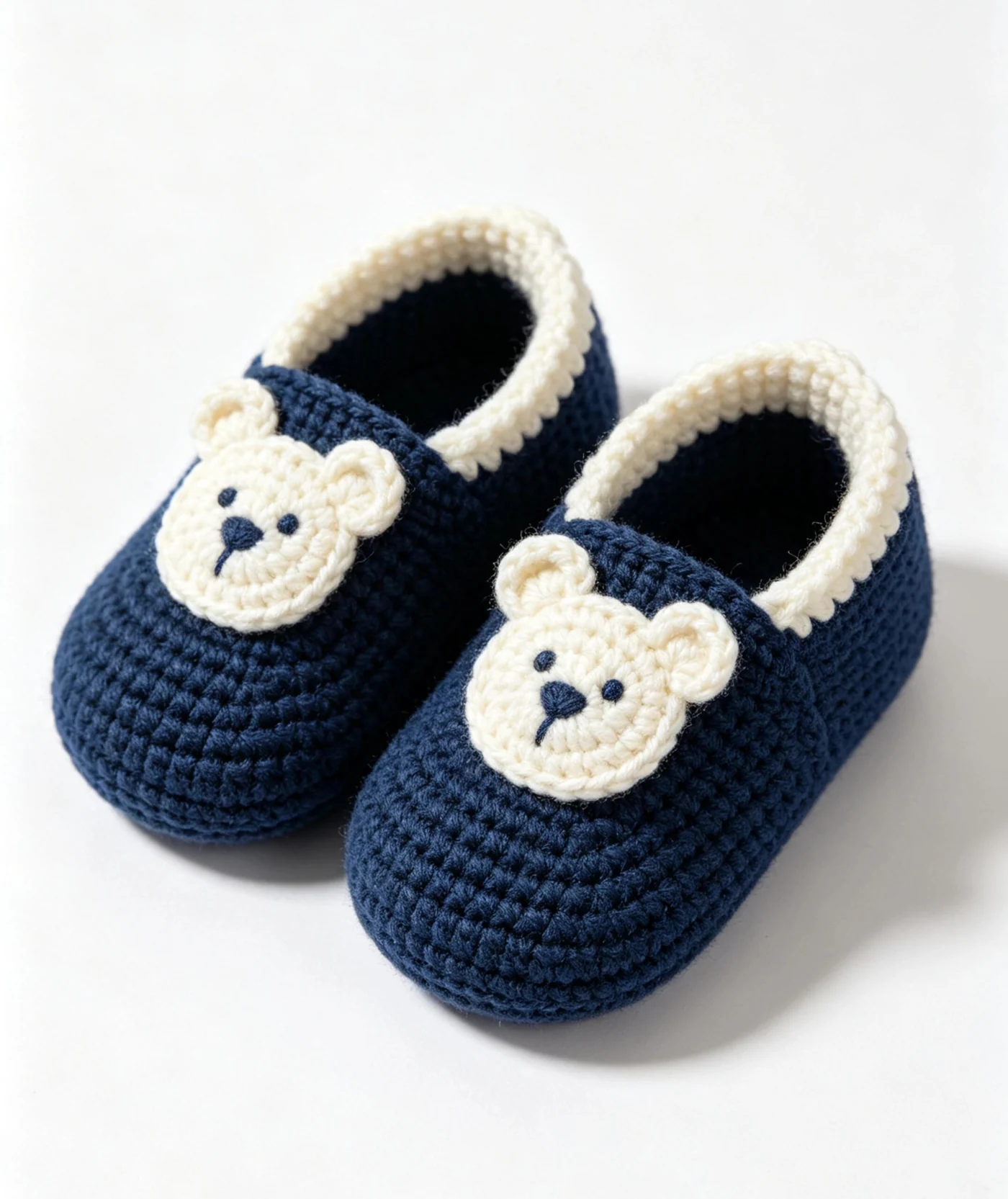
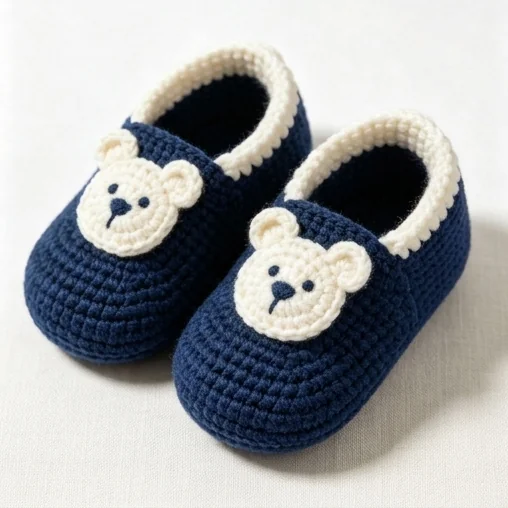
Navy bear baby booties look wonderfully crisp with a creamy scalloped opening and a little embroidered face on each toe. The supplied reference shows low-cut shoes, rounded toes, and fairly flat bear appliqués rather than large stuffed heads. Those small proportions are what make the design feel balanced.
This guide turns the supplied instructions into a step-by-step working draft for bear baby booties. The sole counts balance, but the original toe rounds do not; proposed replacements are clearly marked. A flatter face option is also identified as an adaptation. No physical crochet test, infant-fit test, or exact-photo match is claimed.
Table of Contents
Before Making These Bear Baby Booties
The bear baby booties reference has a flatter face than the seven-round closed shape in the supplied text. Both constructions are explained so that the difference is not hidden. The working version uses an unstuffed three-round circle; its final size and resemblance still need checking on a real shoe sample.
For infant use, avoid beads, buttons, plastic eyes, loose embroidery loops, and added ties. Sew any appliqués and ears securely and inspect them before each use; direct embroidery on the shoe avoids separate appliqué pieces. These choices do not certify the booties as safe. Use appropriate supervision, remove if loose, damaged, or restrictive, and do not treat them as walking or slip-resistant footwear.
Materials, Size, and Gauge for Bear Baby Booties
The supplied bear baby booties notes specify four-ply combed cotton, a 2.0 mm hook, navy for the shoe, and creamy white for the face and edging. Use those as source specifications, but read your own yarn label: “four-ply” does not establish a universal thickness across every yarn market. No measured gauge or yardage was supplied.
- Navy cotton for two soles and shoe bodies; cream cotton for trim, two faces, and four ears.
- A 2.0 mm hook as specified in the source, plus a compatible blunt yarn needle.
- Dark navy or black embroidery yarn, scissors, stitch markers, and a measuring tape.
- No filling for the flat-face working version; no hard facial components.
The source estimates a 9 cm sole for roughly 0–3 months. That is not a fit guarantee: measure the actual foot, then compare the sample’s usable inside length and opening. The outside sole length includes fabric thickness and is not identical to internal foot space. Stop if the shoe presses into the toes, leaves marks, or will not stay on comfortably.
Make one sole before committing to both bear baby booties. Relax or wash the sample according to the yarn label and record its length, width, hook, and yarn. The supplied CH13 suggestion for 3–6 months would change the later counts; it is not a complete graded pattern and is not offered here as a verified second size.
Stitches and Round Conventions
| Source notation | US term used here |
|---|---|
| R / CH | Round / chain |
| X / V / A | Single crochet / sc increase / sc decrease |
| SL / F | Slip stitch / double crochet |
| inc | 2 sc into one stitch |
| dec | sc2tog: work 2 base stitches into 1 new stitch |
| MR / st | Magic ring / stitch |
| [ … ] × n | Repeat the sequence n times |
For joined bear baby booties rounds, ch 1 does not count as a stitch. Join with a sl st into the first actual stitch, not into the starting chain. Do not crochet into the join on the next round. Unless stated otherwise, use both loops; the source does not call for a BLO or FLO sole ridge.
To work sc, insert the hook, yarn over and pull up a loop, then yarn over and draw through both loops. For dec, pull up a loop in each of two stitches and draw through all three loops. A dc uses a yarn over before insertion and finishes by drawing through two loops twice.
Step 1: Crochet the Navy Oval Soles
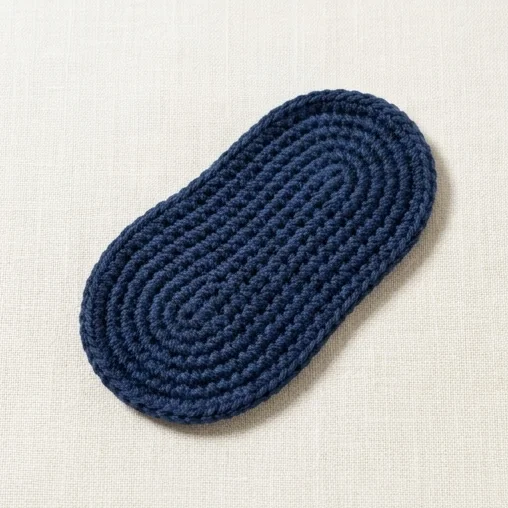
Make two bear baby booties soles in navy. Chain 11 without pulling the foundation tight. Work around both sides of that chain to form an oval, increasing at its ends. Mark the first real stitch in each round and count before joining; a hidden extra join stitch can distort the whole shoe.
| Round | Instruction | Count |
|---|---|---|
| 1 | From 2nd ch: 9 sc, 3 sc in last ch; rotate, 8 sc along unused underside, 2 sc in starting chain; join | 22 |
| 2 | Ch 1; inc, 8 sc, 3 inc, 8 sc, 2 inc; join | 28 |
| 3 | Ch 1; sc, inc, 8 sc, [sc, inc] × 3, 8 sc, [sc, inc] × 2; join | 34 |
The last two sc of round 1 go into the same starting-chain end that already contains its first sc. Together they complete the curved end. Round 2 consumes twenty-two stitches and adds six; round 3 consumes twenty-eight and adds six again. Those totals support the printed thirty-four-stitch sole, not a proven 9 cm measurement.
Lay the bear baby booties soles side by side on a flat surface. If one of your bear baby booties soles twists or cups sharply, check the foundation tension and both end groups before continuing. Don’t pull the oval into shape simply to match a ruler; correct the stitches and measure the fabric in its relaxed state.
Step 2: Raise the Sides and Shape the Toes
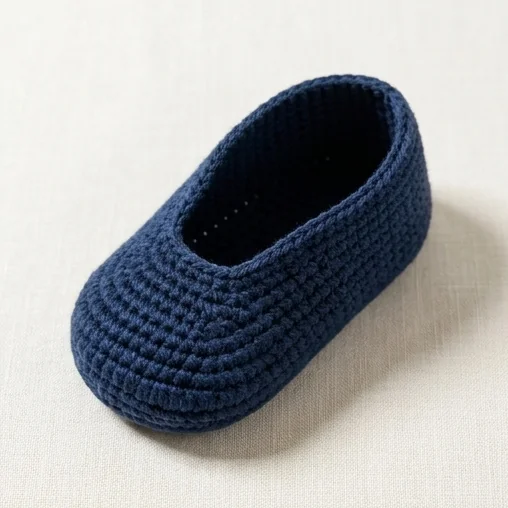
For this proposed bear baby booties shaping, establish the start at the heel center. After sole round 3, fasten off and rejoin navy at the midpoint of the heel curve if necessary. Repositioning the start is an explicit working choice, not a detail provided in the original instructions. It keeps the decrease groups aimed toward the toe.
| Round | Instruction | Count |
|---|---|---|
| 4–6 | Ch 1; sc in all 34 sts; join each round | 34 each |
| 7 · proposed replacement | Ch 1; 12 sc, 5 dec, 12 sc; join | 29 |
| 8 · proposed replacement | Ch 1; 9 sc, 5 dec, 10 sc; join | 24 |
Work the first of your bear baby booties before repeating the corrections on the second. Check that the opening remains usable and the toe sits over the sole rather than collapsing into it. Count the twenty-four opening stitches. If the fabric pulls diagonally, review heel-marker placement; arithmetic alone cannot guarantee the photographed shape.
Step 3: Add the Cream Scalloped Edge
Join cream at the heel opening of the bear baby booties. Round 9 is one sc into each of the twenty-four opening stitches, joined with a sl st. Keep the navy-to-cream join neat and leave enough tail for secure weaving rather than a bulky knot against the foot.
For round 10, interpret each source group as a shell worked into ONE base stitch: [sc, 2 dc, sc] into the next stitch, skip one stitch, and repeat around. Twenty-four base stitches give twelve shells. Each shell contains four worked stitches, so there are forty-eight stitches in the scalloped edge before joining.
This grouping is an explicit interpretation of the supplied ruffle notation. Keep the skipped stitch truly empty, and do not accidentally spread the four shell stitches over four bases. On bear baby booties, a loose decorative edge still needs to lie clear of the foot opening. If the shells are too bulky for your yarn, change the sample rather than forcing the opening to fit.
Step 4: Make the Bear Faces and Four Ears
Working version: two flat, unstuffed faces
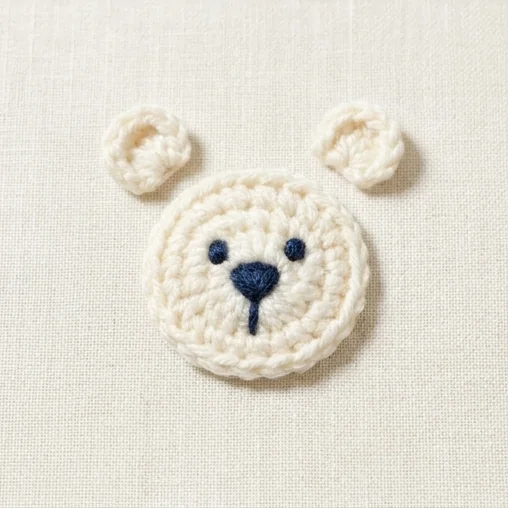
For each of the bear baby booties faces, use cream and work 6 sc in a magic ring. Round 2: inc in every stitch for 12. Round 3: [sc, inc] six times for 18. Join and fasten off with a long sewing tail. Stop here for the proposed flat adaptation; do not add the source’s closing rounds.
This three-round circle is a practical alternative, not confirmation of the exact construction in the photo. Check it against the toe before making both faces. If it overlaps the foot opening or extends beyond the shoe sides, stop and adjust a sample rather than sewing it on because the stitch count is correct.
How the supplied three-dimensional face differs
| Source face round | Instruction | Count |
|---|---|---|
| 1 | 6 sc in MR | 6 |
| 2 | 6 inc | 12 |
| 3 | [sc, inc] × 6 | 18 |
| 4–5 | sc around | 18 each |
| 6 | [sc, dec] × 6 | 12 |
| 7 | 6 dec; close with tail | 6 |
Those extra straight and decreasing rounds form a small closed three-dimensional shape, not a flat circle. The source also mentions minimal stuffing, which conflicts with calling the result a flat patch. This guide uses the unstuffed circle instead for the working bear baby booties; the seven-round source option is retained for comparison, not silently substituted.
Make four ears: two per face
| Ear round | Instruction | Count |
|---|---|---|
| 1 | 4 sc in MR | 4 |
| 2 | 4 inc | 8 |
| 3 | [2 sc, dec] × 2; fasten off | 6 |
Fold each small ear in half and leave it unstuffed in this working version. The source suggests a tiny amount of filling; omitting it is a stated adaptation. Sew the folded edges firmly to the upper sides of the face circle, catching both layers. Make sure all four ears are attached securely, without exposed loose loops.
Step 5: Embroider and Assemble the Pair
Embroider the bear baby booties faces before attaching them to the shoes. Use small, tidy dark stitches for two eyes, an inverted triangular nose, and a short line beneath it. Secure embroidery tails on the back without hard lumps. Avoid beads and plastic pupils, even if another pattern suggests them.
- Place each face over its toe and compare both shoes from the front before stitching.
- Keep the face clear of the opening; do not narrow the entry with the appliqué.
- Sew around the full face edge using small stitches that do not pucker the navy fabric.
- Check the ear joins and all embroidery, then weave tails through several stitches.
- Inspect inside each shoe for rough joins, long strands, and hard knots before any use.
An appliqué can look secure from the front while its reverse still has a long loose strand. Turn each of the bear baby booties inside out as far as the shape allows and inspect both sides. Directly embroidering a bear on the toe is an alternative if you prefer to avoid separate face and ear pieces altogether.
Troubleshooting and Finishing Checks
The sole is shorter than the source estimate
Compare your yarn thickness, foundation tension, and relaxed sole measurement. A 2.0 mm hook is a source starting point, not a guarantee. Changing hook size can alter width as well as length, so make and measure a new sole rather than declaring the existing bear baby booties a different age size.
The toe twists or the opening becomes too small
Verify the heel-centered start, then recount the two proposed decrease rounds. If the sample still does not fit, stop there: adding a tight ruffle will not repair an undersized opening. Frogging a questionable toe round now is better than hiding the problem beneath a sewn-on bear.
The edge curls or the two bears look uneven
Check that every shell uses one base stitch and is followed by one skipped stitch. Pin both face circles before sewing so that their height and angle match. For care, follow the yarn label, reshape gently, and let the bear baby booties dry completely; no wash or colorfastness test has been performed here.
Bear Baby Booties FAQ
Finish Your Bear Baby Booties
The navy-and-cream contrast does most of the styling for these bear baby booties, so let the stitches and small embroidered faces stay simple. Make one full sample, check the corrected toe shape, and record every change before matching the second shoe. Share your yarn and measured result rather than promising an untested age-based fit.
Keep making with My Crochet Universe
Terminology references: Craft Yarn Council crochet abbreviations and standard yarn weight system.